The Power of Documentation in Early Learning (And Why It Beats Report Cards)

Little Lumos Team
Reviewed by Dr. K. Lakshmi Lalithya, Founder & Principal
We share insights, stories, and practical tips for mindful parenting, straight from our vibrant learning community.
What is documentation in a Reggio Emilia preschool, and why does it tell you more than any report card? Discover how recording children's questions, art, and breakthroughs makes real learning visible — and how Little Lumos in Kakinada does it every day.

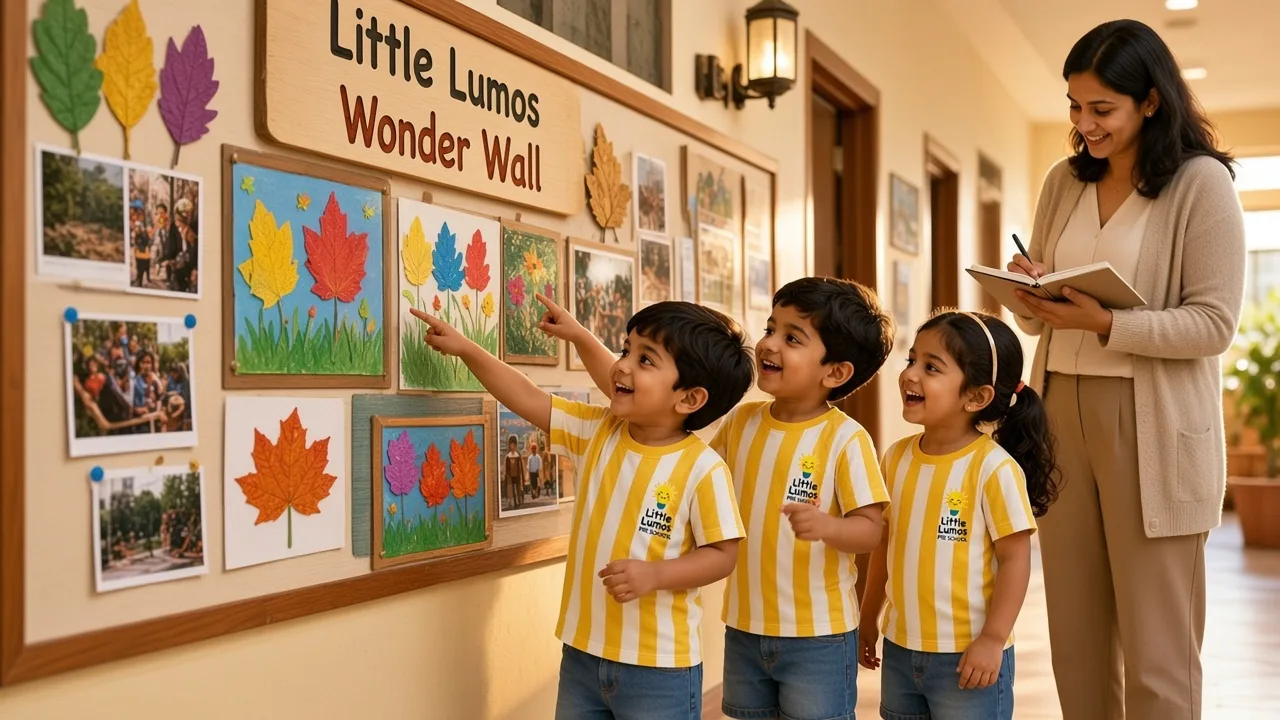
Walk into Little Lumos and you'll see our Documentation Wall. It's not decoration — it's the heartbeat of our teaching practice, and it tells parents far more about their child's growth than a row of marks ever could. Here is what documentation means, why it matters, and how it works.
What Is Documentation in Early Learning?
In Reggio Emilia practice, documentation means carefully observing and recording children's learning processes — not just their finished products. It captures:
- Their questions and conversations
- Their artwork and creative expressions
- Their problem-solving strategies
- Their emotional growth moments
Documentation is one pillar of a much bigger philosophy — read what the Reggio Emilia approach is and why it works for the foundations.
Why Documentation Matters
For teachers: It reveals how children think, not just what they know. That insight shapes planning and lets us design experiences that build on each child's real interests.
For children: When children see their thoughts displayed and valued, they feel respected. They revisit their work and deepen their understanding — "I thought that last week, but now I think this."
For parents: Instead of a report card with grades, you see your child's actual journey — their questions, breakthroughs, and creative leaps. Real growth, not just marks.
Documentation vs. Traditional Report Cards
A report card reduces months of curiosity and growth to a few letters or numbers. Documentation does the opposite: it expands the story. It shows the messy, wonderful middle of learning — the wondering, the trying, the rethinking — which is exactly where the deepest development happens. For young children, that picture is far more honest and useful than a grade.
How We Document Learning at Little Lumos
- Teachers carry small notebooks throughout the day.
- We photograph children's work-in-progress, not just finished products.
- We transcribe children's exact words during conversations.
- We create visual displays that tell the story of a project from start to finish.
This is part of how our Reggio Emilia inspired curriculum comes to life every day, and one of the many reasons families choose Little Lumos.
Documentation turns everyday moments into visible learning. It's not about "Look what I made." It's about "Look how I was thinking."
At Little Lumos in Kakinada, this is part of everyday practice. Read more about how we document learning instead of grading it, or what parents say about seeing it, or book a campus visit.
People Also Ask
Quick answers to the questions parents ask most.
It is the practice of observing, recording, and revisiting children's learning through notes, photos, transcribed words, and displays. It makes children's thinking visible to teachers, parents, and the children themselves.