Lumos Deepa & Dhara: When Little Hands Light Up Diwali the Right Way

Little Lumos Team
Reviewed by Dr. K. Lakshmi Lalithya, Founder & Principal
We share insights, stories, and practical tips for mindful parenting, straight from our vibrant learning community.
This Saturday, Little Lumos hosts Lumos Deepa & Dhara, a Reggio Emilia inspired Diwali morning of flower rangoli and clay diyas. A kinder festival, made by little hands, that the earth does not have to recover from.

Diwali 2026 is already in the air. New clothes on the bed, a box of sweets waiting to be opened, relatives on the way, and that particular glow a row of diyas throws across a room. Somewhere between the sparklers and the rockets, it is worth asking a plain question. What kind of Diwali are we handing to our children?
At Little Lumos, a Reggio Emilia inspired preschool in Kakinada, we think the answer starts early. This Saturday, 7 November, from 9:00 AM to 12:00 PM, we are hosting Lumos Deepa & Dhara. It is a Diwali morning built around the earth, making, and kindness. The brightest Diwali is the one the ground does not have to recover from.
- When: Saturday, 7 November 2026, 9:00 AM to 12:00 PM
- Where: Little Lumos Preschool, Siddharth Nagar, Kakinada
- Who: the children of Little Lumos.
Tiny fingers, a round of flowers
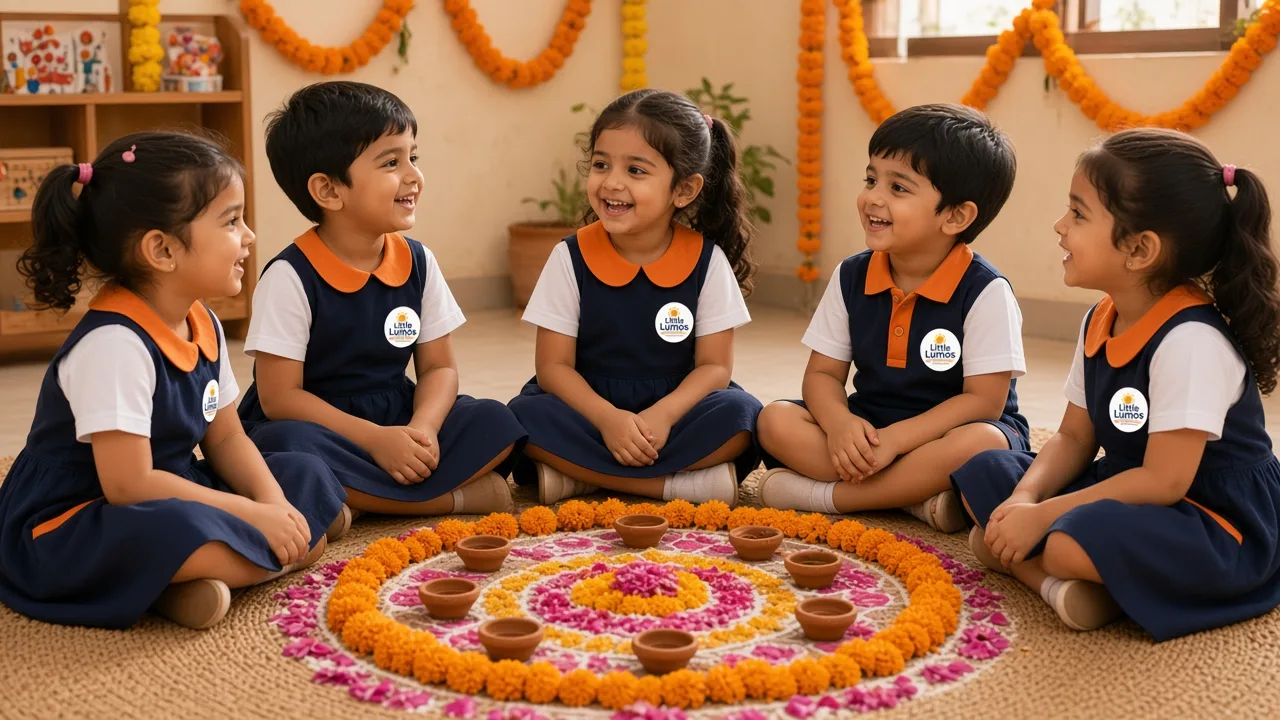
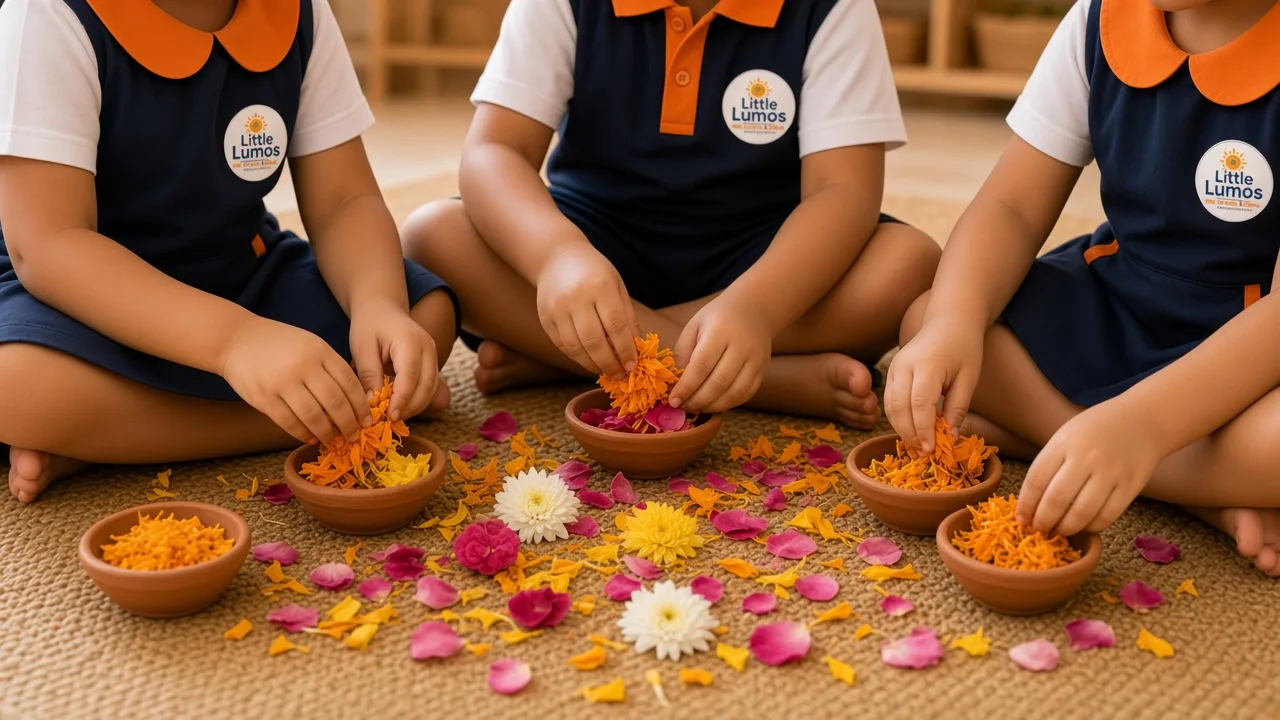
The heart of the morning is the Athapookalam, a flower rangoli made entirely by the children.
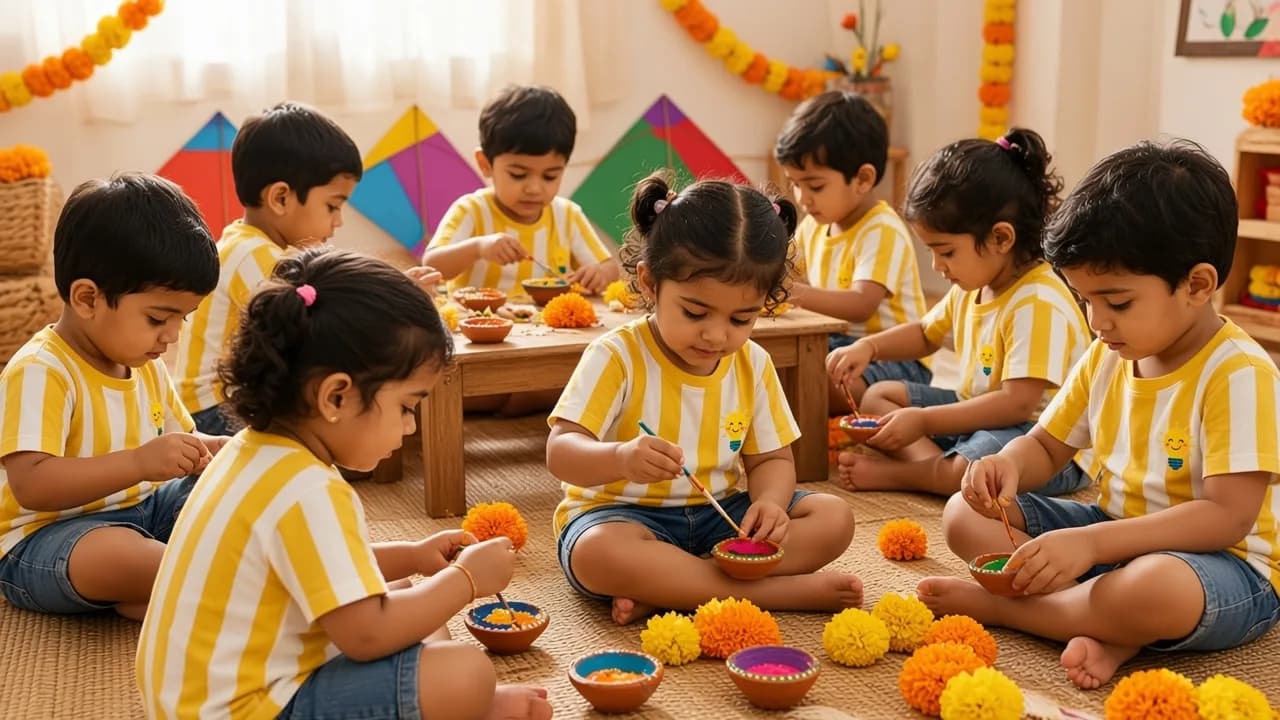
Athapookalam comes from the Onam traditions of Kerala. Fresh petals are laid into a circle, close to the ground, symmetrical if the hands laying them want it to be. When three- and four-year-old fingers take over, something else happens too. There are no stencils and no printed outlines. Children pick marigolds, chrysanthemums and roses. They feel them, sort them by colour, and set them down petal by petal. It is sensory. It is slow. It is art that came from a plant and can go back to the soil.
You do not need chemical rangoli powder or plastic decorations to make something beautiful. The earth already gave us the materials. The work is to use them gently and give them back.
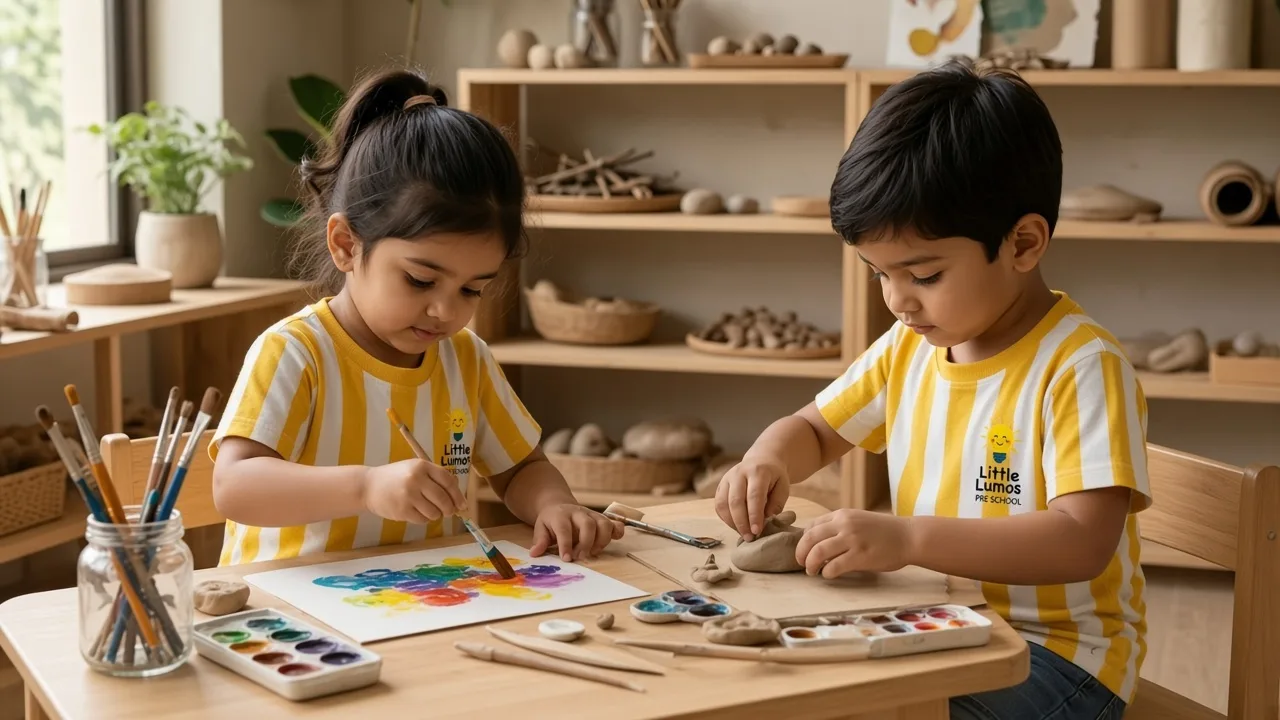
That is the same idea running through an ordinary day here. Children learn with real materials, and they decide what the work becomes. If you want more of that at home, start with art and craft for little hands. Our wider look at festivals with children in Kakinada sits right beside this morning.
Clay diyas, made and lit by the same hands
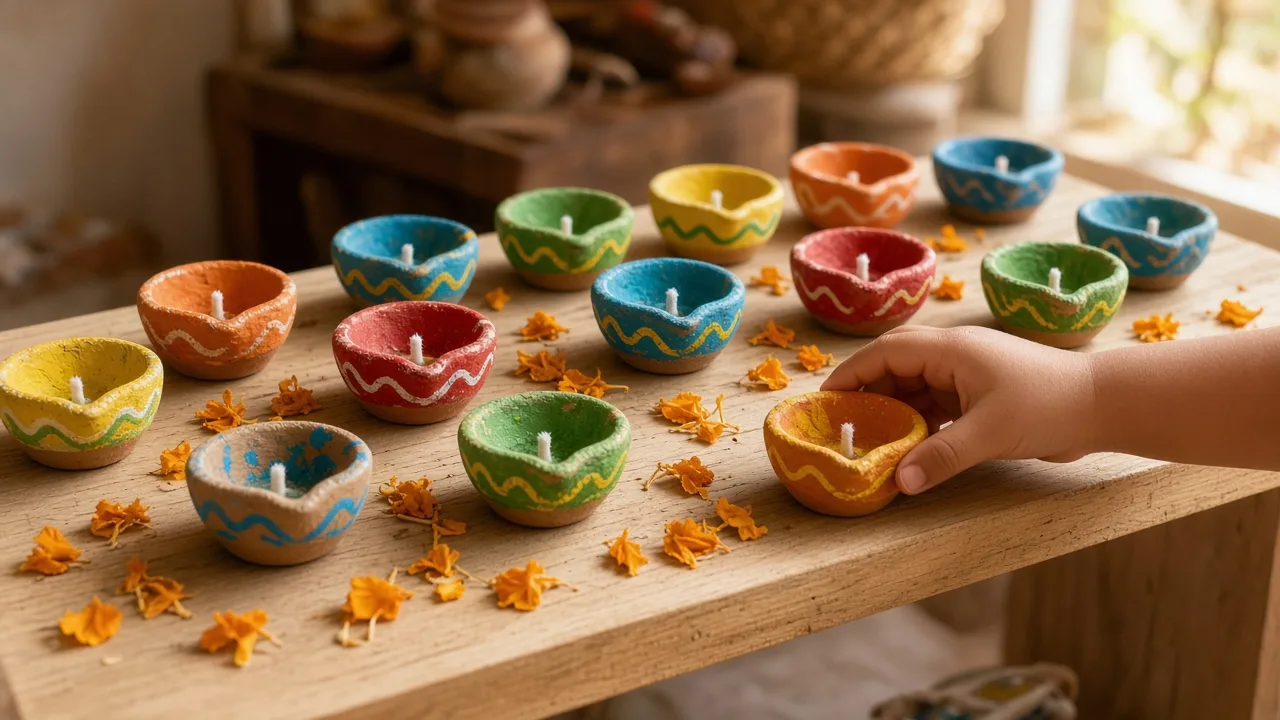
Walk through the celebration and you will find a small gallery that would please anyone who likes looking at children's work. The Mitti Diya Gallery is a row of clay lamps, shaped and painted by the children, set out for families to see.
Working with mitti is one of the most grounding things a young child can do. It asks for patience. It strengthens the small muscles of the hand. It connects them to a craft people have practised for thousands of years. A mud diya, a cotton wick and a few drops of oil have lit Diwali for longer than anyone in the room has been alive. It does not need a battery. It does not throw off the smoke a firework does. It comes from the earth, and it can go back to it.
When a child shapes the lamp herself, the festival stops being something adults perform around her. She owns a piece of it. Tradition and care for the earth stop looking like opposites. They start looking like the same habit.
A simple mud diya has been enough light for thousands of Diwalis.

What the crackers do to animals
Here is the part of Diwali that never makes it onto a greeting card.
Every year, as crackers go off across towns and cities, animals pay for a celebration they did not choose. Stray dogs bolt, sometimes into traffic. Birds leave nests. Pets hide under beds and shake for hours. Cattle on the road startle.
A firecracker close by is often louder than 120 decibels. Dogs hear pitches we cannot, up into the range of about 45,000 to 65,000 hertz, while human hearing fades out near 20,000. For them a cracker is not a celebration. It is a sudden assault on an ear built to notice far more than ours.
The residue does not vanish when the noise stops. Chemicals from fireworks settle on grass, in water, and on food left in the open. Animals that eat and drink there have no other option. Shelters and rescue groups report a rise in burns, injuries and frightened animals through Diwali week, year after year.
Parents are a child's first teachers. A quieter Diwali protects animals, and it also teaches empathy. Celebration does not have to be purchased with someone else's fear. That is a value that outlasts the lights.
Why this Diwali can be different
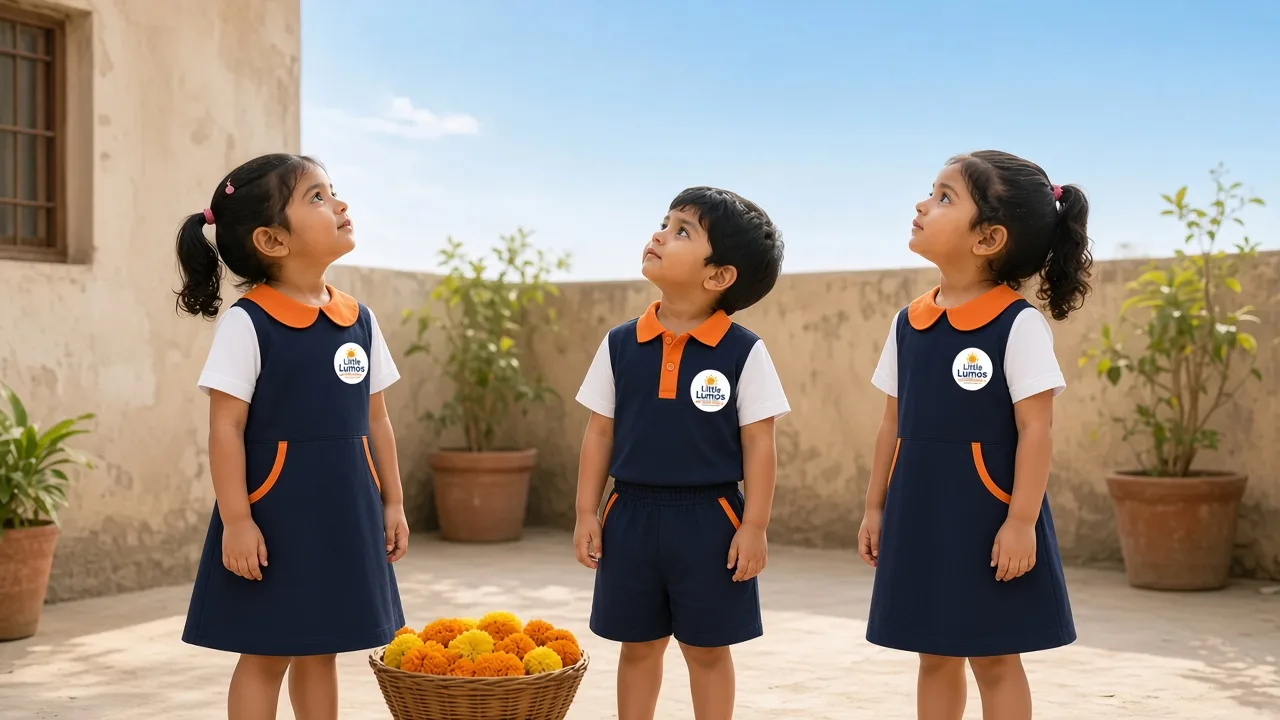
The morning after a heavy cracker night, the air in many Indian cities turns hazardous. In Delhi and other metros, post-Diwali readings have crossed an AQI of 500, the severe-plus range. That is the air children breathe when they wake up. The noise itself breaks sleep and is hardest on infants and older people.
Fireworks also release sulphur dioxide, fine dust and other pollutants into air that is already under strain. A single household skipping crackers will not clear a city. Hundreds, then thousands, then lakhs of households choosing differently is how a small decision becomes a real one. The habits formed at three and four are the ones that travel. A preschool Diwali is not only a Saturday morning. It is a picture of what a festival can be.
If your family still lights a few
A Diwali with no sparkle at all feels unfinished for many homes. If you do include fireworks, keep the little ones protected.
- Stay with children the whole time. Never leave a child to light a cracker alone.
- Keep a bucket of water and a basic first-aid kit within reach.
- Wear cotton. Synthetic fabric catches quickly and can melt onto skin.
- Light fireworks in an open space, away from vehicles, gas cylinders and dry plants.
- Once a cracker is lit, step back. If it seems like a dud, do not go back to relight it.
- Douse spent crackers in water before you throw them away.
- Keep pets in a quiet room, and check on them often.
- If someone is burned, run cool water over the area for at least ten minutes and get medical help straight away.
Try this instead
Skip the crackers. Light the mud diyas, make a flower rangoli, share sweets with the neighbours, play a board game, or sit together in a well-lit room. The joy of Diwali was never in the noise. It was always in the light.
A festival worth passing on
We are not interested in taking the fun out of a festival. We are interested in putting the meaning back in. Lumos Deepa & Dhara is our way of showing the children, and reminding ourselves, that Diwali is light meeting darkness. It is not smoke meeting clean air.
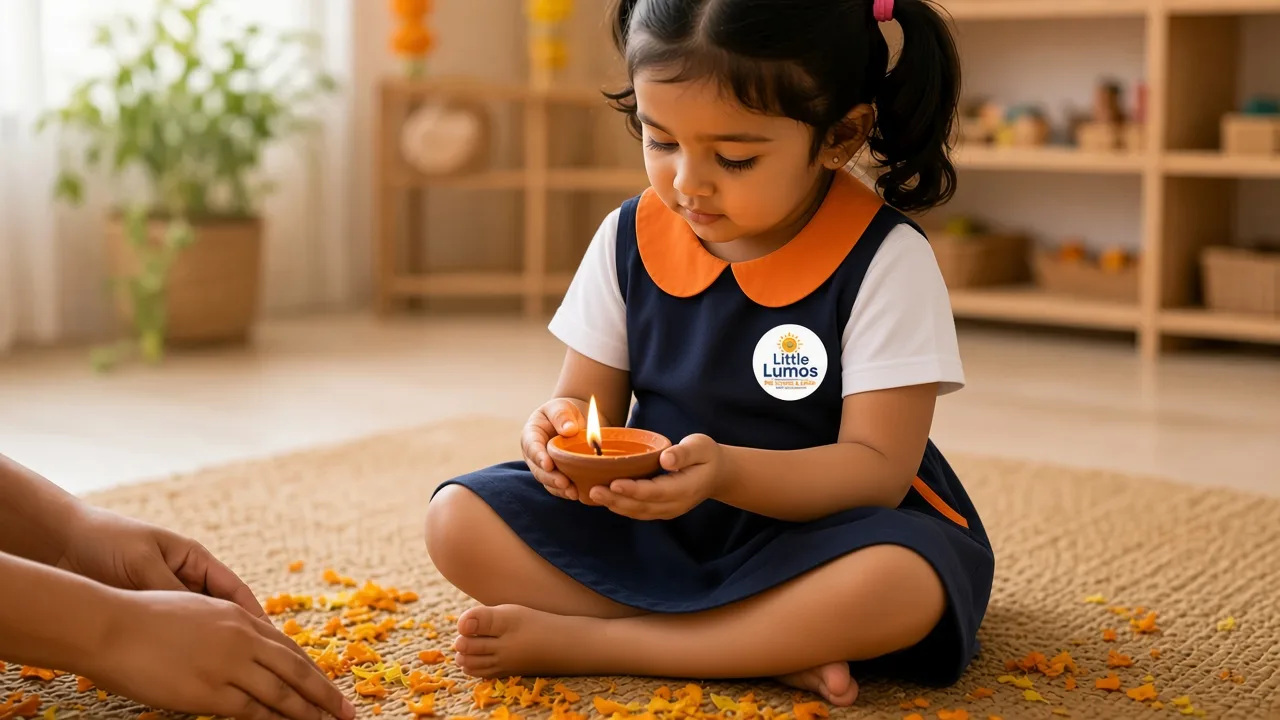
When a three-year-old sets a marigold petal into an Athapookalam, or cups a diya she shaped herself, she is not only celebrating. She is practising how to belong to the earth.
If you want a Reggio Emilia inspired preschool in Kakinada that keeps festivals intentional, you are welcome to visit us and see the morning. Families can also see what else is happening at the campus.
Happy Diwali 2026, from the Little Lumos family. Let us light the world without burning it down.
At Little Lumos in Kakinada, this is part of everyday practice. Read more about upcoming events at Little Lumos, or our Reggio Emilia approach, or book a campus visit.
People Also Ask
Quick answers to the questions parents ask most.
Lumos Deepa & Dhara is on Saturday, 7 November 2026, from 9:00 AM to 12:00 PM at Little Lumos Preschool, Siddharth Nagar, Kakinada.