Montessori vs Reggio vs Play-based Playschool in Kakinada: A Parent's Guide

Little Lumos Team
Reviewed by Dr. K. Lakshmi Lalithya, Founder & Principal
We share insights, stories, and practical tips for mindful parenting, straight from our vibrant learning community.
Montessori, Reggio-inspired, or a play-based playschool — the boards all look similar in Kakinada. Take the interactive quiz to find your child's fit, compare all three side by side, and learn what parents here value most before you choose.

Take a drive through Kakinada and you'll notice the same three phrases on almost every preschool board: Montessori, Reggio-inspired, and play-based playschool. For a parent trying to choose, the labels blur together fast — they all promise happy children, caring teachers, and a bright future. So what actually separates them, what do they cost here, and how do you pick the right one for your child?
This guide answers exactly that, honestly. We'll compare all three approaches side by side and tell you what local parents say matters most. We'll also be upfront about our own philosophy: Little Lumos is Kakinada's first Reggio Emilia inspired preschool. But our goal here is to help you choose well, whatever you decide.
Use the interactive tools on this page to:
- Take a one-minute quiz to see which approach fits your child
- Compare Montessori, Reggio Emilia, and play-based playschools side by side
- Learn what Kakinada parents value most, drawn from hundreds of local reviews
- Get clear answers to the questions parents ask before choosing
How each approach actually teaches
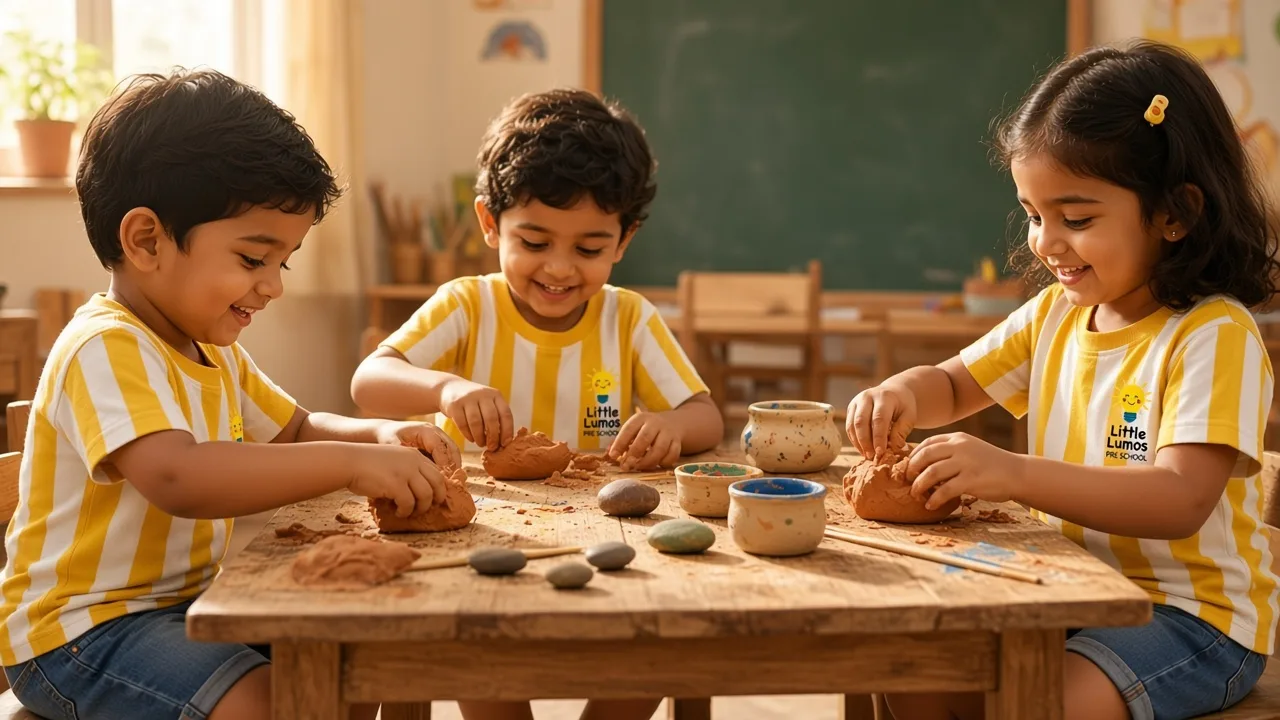
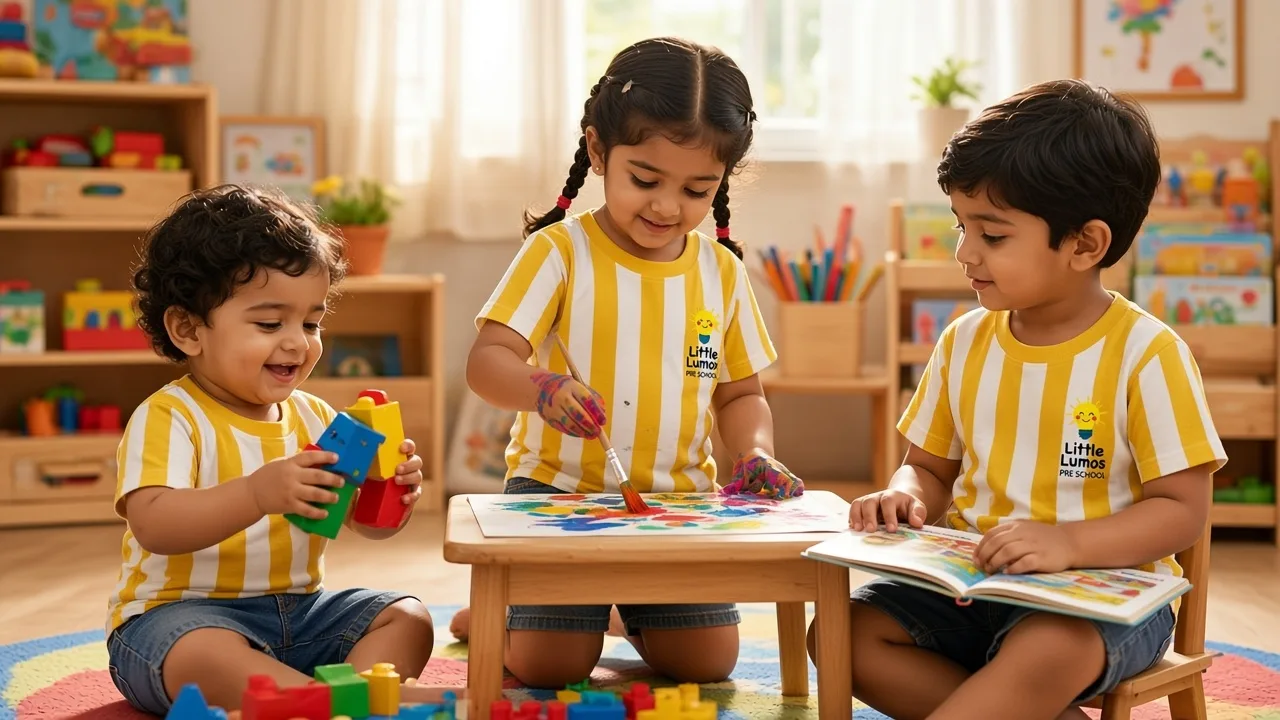
The deepest difference is who drives the learning. In Montessori, the child leads within firm boundaries, choosing from a prepared set of self-correcting materials and working independently while a trained directress observes and steps in sparingly. In Reggio Emilia, the child and teacher steer together — learning grows from the children's own questions through open-ended projects, with the environment treated as a third teacher. In a play-based playschool, the teacher plans a warm, activity-filled day of rhymes, themes, craft, and free play, usually following a set weekly plan.
What Kakinada parents actually value
Read hundreds of local preschool reviews and the same four themes appear long before anyone mentions a method: caring, patient teachers who treat children like their own; a safe, clean, hygienic campus; a child who is genuinely happy to go each morning; and real, two-way communication with parents. Whatever approach you lean toward, insist on these.
Which is right for your child?
There's no universally correct answer, only the right fit. Montessori suits children who love order, routine, and repetition, and parents drawn to a calm, methodical room. A play-based playschool suits families who want a happy, sociable, low-pressure first taste of school. The Reggio Emilia approach suits families who want creativity, curiosity, and emotional confidence protected — who care how a child learns as much as what they memorise. When you tour any school, look past the label and watch the children: are they relaxed, busy, and engaged? That tells you more than any brochure.
Why we chose Reggio Emilia at Little Lumos
We built Little Lumos around the Reggio Emilia approach because we believe it protects something precious in the early years — a child's natural, fierce curiosity. We wanted children who could wonder, question, create, and feel deeply, in a screen-free, art-rich, relationship-centred day. That said, we have deep respect for dedicated Montessori educators and warm play-based teachers alike. What matters most is not the name above the door, but whether your child is seen, safe, and free to grow. Come and see a real Reggio classroom in Siddharth Nagar, Kakinada — and ask us anything, including how we compare.
| Montessori | Reggio-inspired | Play-based playschool | |
|---|---|---|---|
| Core idea | Independence through structured materials | Children as capable thinkers and researchers | Learning through free and guided play |
| A typical morning | Individual work cycles with set materials | A group project that may run for weeks | Rotating play stations and circle time |
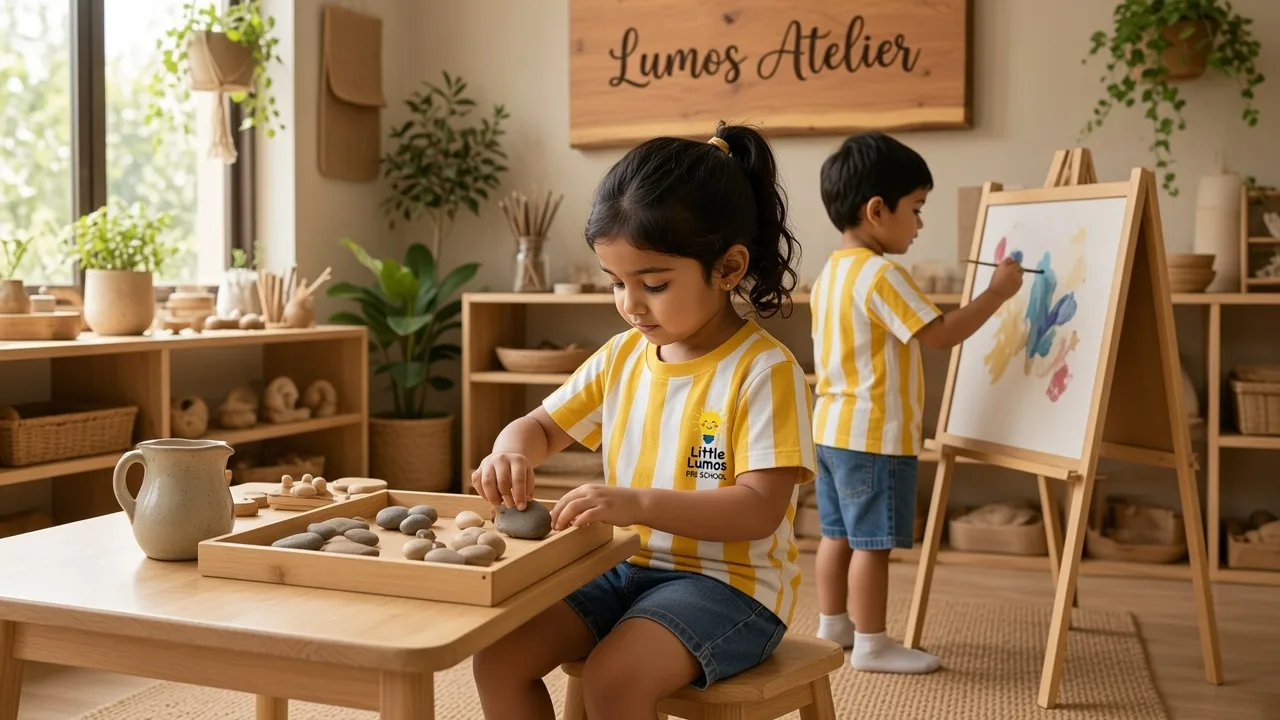
| Classroom feel | Calm and orderly, materials on low shelves | Studio-like, children's work on the walls | Colourful and toy-rich, activity corners |
| Screens | Usually none | Usually none | Varies widely — ask directly |
| Ask on a campus visit | Are the staff Montessori-trained? | Is there a real atelier and documentation? | What is the adult-to-child ratio? |
| Watch out for | The word used without trained staff | 'Reggio' used as decor rather than practice | Play used to mean unstructured supervision |
Interactive tools
Which one fits your child?
A one-minute quiz, a side-by-side comparison, and what Kakinada parents say actually matters to them.
Interactive quiz
Which Approach Fits Your Child?
Answer five quick questions. There are no wrong answers, just the fit that suits your child and your family.
1. Which sounds most like your child right now?
2. What matters most to you in these early years?
3. Which classroom would you love to peek into?
4. How do you feel about screens and worksheets for under-6s?
5. A year from now, you'd most love to hear that your child…
Side by side
Compare the Three Approaches
Pick an approach to see how it teaches across every dimension parents care about.
Now viewing
Montessori
Created in the early 1900s by Dr Maria Montessori, an Italian physician. It uses a precise system of self-correcting materials and independent, child-chosen work.
Who drives the learning?
The child leads within firm boundaries. Children pick from a prepared set of specially designed materials and work on their own, moving to the next material when the teacher judges them ready.
Materials & environment
Beautiful, exact, self-correcting equipment, each piece teaches one concept, usually with a single correct way to use it. Mastery comes through quiet repetition.
Role of the teacher
A trained observer who demonstrates a material, then steps back and intervenes as little as possible.
Art, play & imagination
Leans toward practical, real-life activities. In its purest form it gives less room to pretend play and open-ended fantasy.
Best suited for
Children who thrive on order, routine and repetition, and parents who love a calm, methodical room focused on concentration and practical independence.
Montessori
Children who thrive on order, routine and repetition, and parents who love a calm, methodical room focused on concentration and practical independence.
Reggio Emilia
Families who want creativity, curiosity and emotional confidence protected, who care how a child learns as much as what they memorise, and who want wonder over worksheets.
Play-based playschool
Families who want a happy, sociable, low-pressure start with familiar structure, rhymes and lots of friends.
Beyond the label
What Kakinada Parents Actually Value
Read hundreds of local preschool reviews and the same four things come up, long before anyone mentions a method. Whatever approach you lean toward, insist on these.
Caring, patient teachers
The #1 thing parents mention, staff who treat children 'like their own'.
Safe, clean, hygienic space
A spotless, secure campus comes up again and again in local reviews.
A child who's happy to go
Parents celebrate kids who wake up excited for school every morning.
Real communication
Families want to feel heard and updated, not just a drop-off point.
See a Real Reggio Classroom in Kakinada
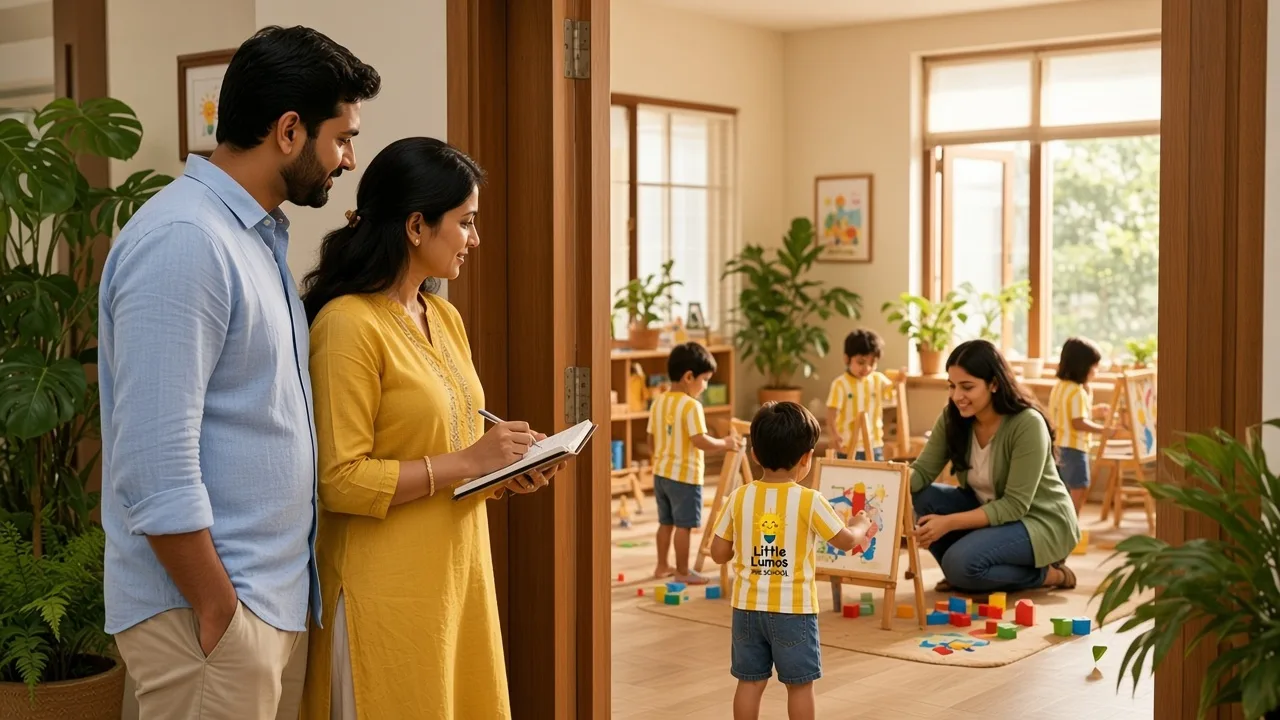
The best way to choose is to stand in a classroom and watch children learn. Tour Little Lumos in Siddharth Nagar, meet our educators, see the atelier, and ask us anything, including how we compare to Montessori and play-based options. We welcome children aged 2 to 6.
At Little Lumos in Kakinada, this is part of everyday practice. Read more about Kakinada's first Reggio Emilia inspired preschool, or how our classrooms are set up, or book a campus visit.
People Also Ask
Quick answers to the questions parents ask most.
They aren't really rivals. Montessori, Reggio, and play-based are early-years approaches for ages 2 to 6, while CBSE is a school board that begins formal academics from Grade 1. For the preschool years, focus on how your child is cared for and how they learn through play rather than the board. A curious, confident, happy child settles into any board later.