Active Play & Gross Motor Skills: Fun Ways to Build Strong Bodies

Little Lumos Team
Reviewed by Dr. K. Lakshmi Lalithya, Founder & Principal
We share insights, stories, and practical tips for mindful parenting, straight from our vibrant learning community.
Neat handwriting at six is built on climbing at three. What that actually means, the four kinds of movement most children now miss, and what works in a two-bedroom flat.

"Don't climb, you'll fall." "Slowly, slowly." "Come and sit, don't run inside."
Between a two-bedroom flat, a road nobody would let a child walk on alone, and three adults who each say some version of this about forty times a day, a great many Indian children now grow up doing remarkably little with their bodies.
And then, at four, the same household starts worrying about handwriting.
Those two things are connected far more tightly than most parents realise, which is where this is worth starting.
Writing is built on climbing
Development runs outward from the middle of the body. A child first gains control of their trunk, then their shoulders, then their elbows, then their wrists, and only then their fingers.
This is not a metaphor. To write, a child needs to sit upright without slumping, which requires core strength. They need a stable shoulder to hold the arm steady, so that the fingers can do small precise work. If the core is weak, the child props themselves on the table, tires within minutes, and the writing is poor no matter how much they practise.
So the parent who wants neat handwriting at six should be actively encouraging climbing, hanging, crawling and carrying at three.
The hands come last, and they come from the body.
How much movement a young child actually needs
International guidance suggests around three hours of physical activity across the day for toddlers and preschoolers, with a good chunk of it energetic.
That number startles most parents. It should not be read as three hours of organised activity. It is walking, climbing on furniture, dancing, chasing, carrying things, squatting to play, and the general business of a child who is not being asked to sit still. Free play counts. Most of it should be free play.
Little and often is the shape of it. Six ten-minute bursts across the day does more than one long session, and fits real life better.
What is usually missing
Most children get some running. The gaps tend to be in four specific areas, and these are the ones worth adding deliberately.
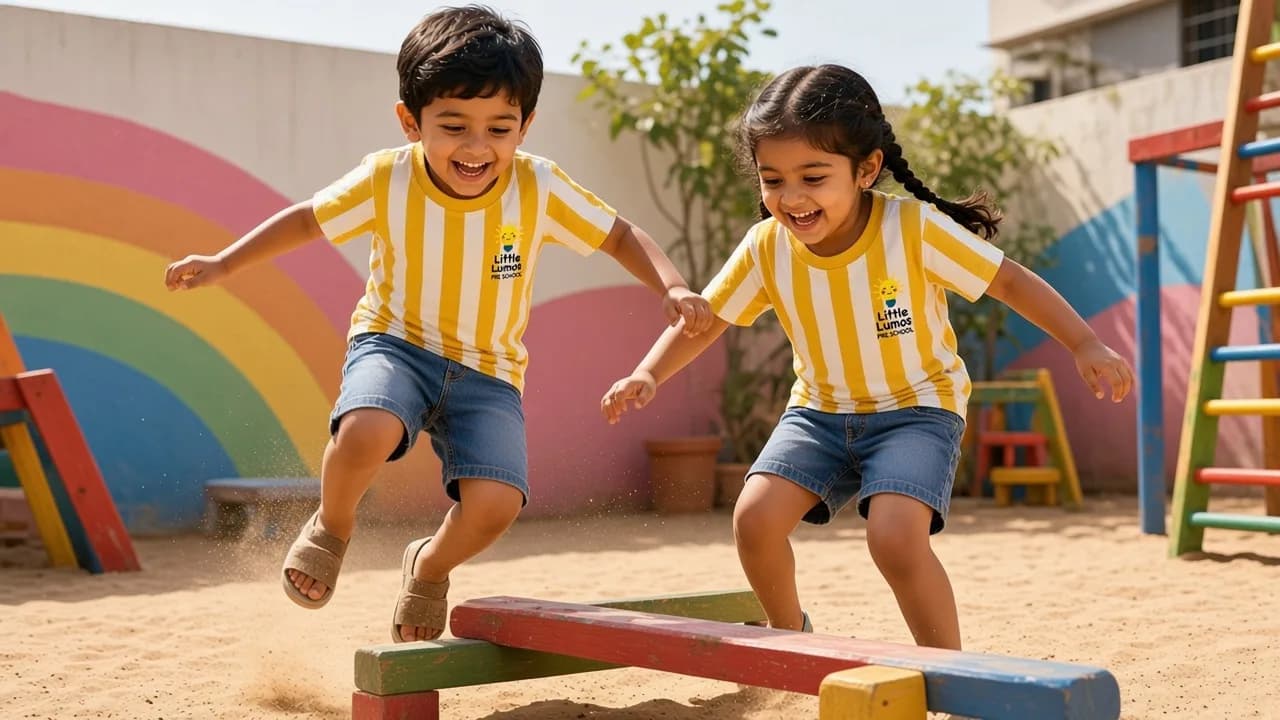
Upper body and hanging. Very few children now hang from anything. Hanging from a bar, monkey bars, or even a sturdy door frame handle builds the shoulder girdle that writing depends on. If there is a park with bars within reach, it is worth the trip for this alone.
Carrying heavy things. Pushing, pulling and carrying weight gives the body strong feedback that helps children feel where they are in space, and it is noticeably calming. Let them carry the water bottle, push the chair, drag the bag of rice a metre.
Spinning and swinging. Movement that changes the position of the head builds balance and body awareness. Swings, spinning in circles, rolling down something. Children seek this out naturally, and adults usually stop it.
Crawling. Not just for babies. Crawling under the bed, through a tunnel of chairs, across the floor like a crab, uses both sides of the body in opposition, which is genuinely good for coordination.
A rough map, by age
One to two. Walking steadily, beginning to run, climbing onto low furniture, squatting to pick things up, rolling and throwing a ball.
Two to three. Running with control, jumping with both feet off the ground, kicking a ball forward, walking up stairs, pedalling a ride-on.
Three to four. Pedalling a tricycle, hopping, catching a large ball with the whole body, walking along a line, going up stairs with alternating feet.
Four to six. Hopping on one foot, skipping, catching a smaller ball with the hands, balancing on one leg, climbing confidently, riding a bicycle.
Children arrive at each of these at their own pace, and a few months either way means nothing.
If you live in a flat, which most of us do
None of the following needs space, equipment or a garden.
Animal walks up and down the corridor: bear walk on hands and feet, crab walk on the back, bunny jumps, giant tiptoe steps. Balloon keep-it-off-the-floor, which is the single best value activity in this entire article and costs five rupees. Freeze dance. A cushion obstacle course: over the pillow, under the chair, around the table, repeat. A line of tape on the floor to balance along. Pushing a loaded laundry basket across the room. Climbing the stairs of your building instead of using the lift.
Ten minutes of any of these before something that requires sitting will buy you more stillness than an instruction to sit still ever has.
Working around the Kakinada heat
For a good part of the year, the middle of the day is simply not usable, and pretending otherwise leads to an indoor child.
Shift outdoor play to before nine in the morning and after five in the evening, which is when everybody else's children are out too. Through the hot hours, do the indoor list above, and lean on water play, which cools and gives the body a lot of useful resistance at the same time. A wide vessel of water on the balcony with a few cups occupies a small child for a surprisingly long time.
Our outdoor games library and indoor games library have more if you need a longer list.
About "you'll fall"
This is the difficult one, because it comes from love, and because in a joint household there are usually several people saying it.
A child climbing something slightly beyond what they have done before is doing important work. They are assessing height, testing grip, judging their own limits. That judgement is built by practising it, and a child who is never allowed to test it does not become safer. They become a child with no idea what they can do, which is its own risk.
The distinction that helps is between a hazard and a challenge. A hazard is something the child cannot see: a loose railing, a drop they have not noticed, traffic. Adults should remove hazards without discussion. A challenge is something the child can see and has chosen: climbing a bit higher, jumping from the step. That is the part to leave alone, while standing close enough to be useful.
Standing close and saying nothing is a skill. It is also worth agreeing on with the grandparents in advance, quietly, rather than in the middle of a climb.
Try this this week
Add one ten-minute burst of proper movement immediately before whatever part of the day usually goes badly: before dinner, or before the drive to school. Not as a reward, not afterwards. Before. Most families notice the difference in the thing that follows it.
At Little Lumos in Siddharth Nagar, movement is not a break from learning and it is not a period on the timetable. It runs through the day, indoors and out, because a child who has moved properly is a child who can then sit, attend, and think. Our guide to fine motor skills and writing readiness picks up where this one leaves off.
Interactive tools
Find something to do today
Pick your child's age for movement milestones and ideas that work indoors and out, or tap for a surprise activity you can start in five minutes.
Interactive finder
Active Play by Age
Pick your child's age band to see the typical movement milestones and simple indoor and outdoor ideas to try.
What to expect at 2–3 years
- Running with more control
- Jumping with both feet
- Kicking a ball forward
- Climbing stairs with support
Indoor ideas
- Balloon keep-it-up
- Animal walks (bear, crab, bunny)
- Simple obstacle course with pillows
- Freeze dance
Outdoor ideas
- Ride-on and push cars
- Throwing beanbags into a bucket
- Running games
- Climbing at the park
Beat the boredom
Need an Idea Right Now?
Tap the button for an instant, no-equipment active-play idea you can do in the next five minutes.
The bigger picture
Why Gross Motor Play Matters So Much
Big-body movement is brain food. It builds far more than muscles.
Strong body & core
Big movements build the muscles and stability that even sitting and writing later depend on.
Sharper brain
Movement and cross-body coordination fire up focus, memory and learning.
Better sleep & mood
Active play burns energy, lifts mood, and helps little ones settle at night.
Confidence & courage
Climbing, balancing and trying again builds real self-belief.
Where Little Bodies (and Minds) Grow
At Little Lumos, active, screen-free play is woven through every day, indoors and out. Tour our campus in Siddharth Nagar, Kakinada, and see how movement, wonder and learning come together for children aged 2 to 6.
Sources
- Guidelines on physical activity, sedentary behaviour and sleep for children under 5 years of age, World Health Organization
At Little Lumos in Kakinada, this is part of everyday practice. Read more about our hands-on early years curriculum, or preschool programs for ages 2 to 6, or book a campus visit.
People Also Ask
Quick answers to the questions parents ask most.
Gross motor skills are the big movements that use the large muscles of the arms, legs and torso: walking, running, jumping, climbing, throwing, catching and balancing. They're the foundation for coordination, posture and stamina, and they develop before the fine, precise hand movements used for writing.