Tantrums & Discipline: A Calm Parent's Playbook

Little Lumos Team
Reviewed by Dr. K. Lakshmi Lalithya, Founder & Principal
We share insights, stories, and practical tips for mindful parenting, straight from our vibrant learning community.
What is really happening when a toddler goes down on the floor in a shop, why reasoning cannot work in that moment, and the words that do. Including what to do about the audience.
- A tantrum is not a decision
- Two different things that look identical
- What to do while it is happening
- Afterwards, which is where the learning happens
- The four things that make it worse
- Prevention is unglamorous and works better than anything else
- A word about the grandparents
- When it is worth asking someone
- Interactive tools

It is almost never at home.
It is in the middle of a shop, or at a function, or at the exact moment you are trying to leave somewhere. Your child is on the floor. And within about eight seconds there is an audience: a shopkeeper, two aunties, and someone helpfully saying "Chi chi, see, everyone is looking at you."
That last part is the hardest bit of parenting a toddler in India. You are not only managing your child. You are managing a small crowd with opinions, and the pressure to make it stop immediately, by whatever means, is enormous.
So it is worth being clear about what is actually happening on that floor, because it changes what you do next.
A tantrum is not a decision
The part of the brain that manages impulses, holds on to reason under stress and talks itself down is, at two and three years old, barely built. It continues developing well into adulthood.
So when a small child is overwhelmed, they are not weighing up options and choosing to scream. The system that would have done the weighing has gone offline. They have big feelings, almost no vocabulary for them, and no brakes.
This is why reasoning mid-tantrum does not work, and why it can never work. You are addressing a part of the brain that is not currently receiving messages.
It is not that your child won't listen. It is that they can't, yet.
Two different things that look identical
Before you respond, it helps to know which one you have.
Overwhelm. Tired, hungry, overstimulated, or something didn't go the way they expected. The child has lost control and is frightened by it. This one needs comfort, not a lesson. You are the calm they cannot generate themselves.
A limit being tested. They want the chocolate, they know the answer is no, and they are applying pressure. This is not bad behaviour either, it is a child doing their developmental job of finding out where the walls are. This one needs a warm, immovable wall.
The tell is usually whether they are checking to see if it is working. A child looking at you between screams is negotiating. A child who has gone somewhere else entirely is overwhelmed.
Both need you calm. They need different things after that.
What to do while it is happening
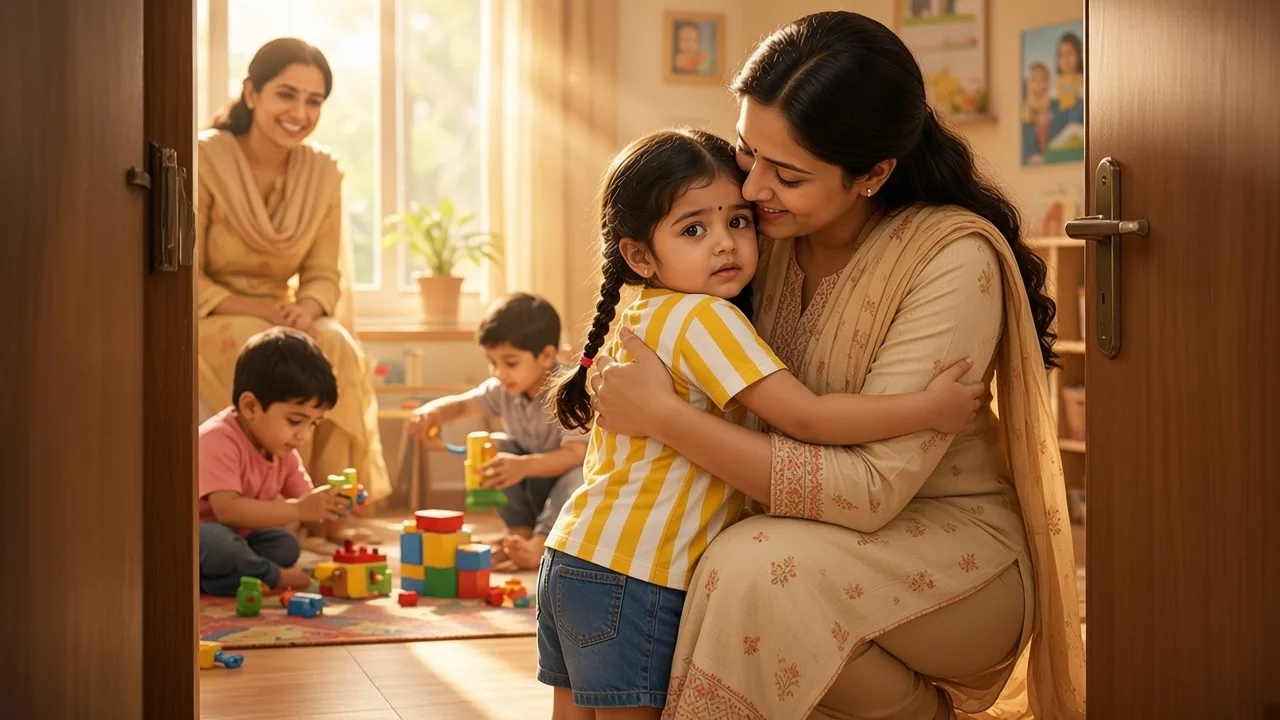
Get low. Kneel down to their height. It changes the whole encounter, for them and for you.
Say much less. Five words, not fifty. "You're upset. I'm here." Then stop. A flood of explanation is more noise pouring into a brain that is already flooded.
Don't try to teach anything. The lesson lands afterwards, when the storm has passed, or it doesn't land at all.
Stay. Walking away, or the threat of it ("fine, I'm going, bye"), is frightening rather than instructive. Sit nearby. You don't have to hold them if they don't want holding. You do have to still be there.
Hold the limit anyway. Being kind is not the same as giving in. "I know. You really wanted it. We're not buying it today." Both halves, every time.
Ignore the audience. Easier written than done. But the aunty will forget this in an hour and your child is learning something from it that lasts considerably longer.
Afterwards, which is where the learning happens
Once they are calm, and not before, you can do the useful part. Keep it short.
Name what happened: "You were so angry when we had to leave the park." Then, if something needs repairing, help them do it rather than demanding a performance. A forced "sorry" delivered through gritted teeth teaches a child how to say a word, not how to mean it. Helping put the thrown blocks back, together, teaches more.
And if you lost your temper too, which you will, say so. "I shouted. I shouldn't have. I was frustrated." A child who watches an adult acknowledge losing control and repair it is learning something genuinely valuable, and it is not a lesson you can deliver any other way.
The four things that make it worse
Shouting. It escalates a child who is already flooded, and it demonstrates that shouting is what people do when they are overwhelmed. They are watching very carefully.
Hitting. Setting aside everything else, it teaches that big people hit small people when frustrated, and that lesson gets applied on the school playground within the week.
Threats you will not carry out. "If you don't come now I'll leave you here." You won't, they work out that you won't, and every future instruction loses a little weight.
Shame. "Everyone is laughing at you." "Big boys don't cry." "Look how nicely that child is sitting." Shame stops behaviour quickly and teaches the child that some of their feelings make them unacceptable. That bill arrives much later.
Prevention is unglamorous and works better than anything else
Most tantrums are, in a sense, scheduled. They happen at the same two or three times each day: before lunch, late afternoon, and at bedtime. Hunger and tiredness are the two biggest triggers in most households, and neither has anything to do with discipline.
The other big one is transitions. Children are absorbed in something and then required to stop immediately, which is genuinely hard, and a great deal of what looks like defiance is really the difficulty of switching.
Warn before you switch. Not vaguely. "Two more rounds of the slide, then shoes." Then a second warning: "One more." Then follow through calmly, even through protest. Done consistently, this alone removes a large share of daily conflict, because the child stops being ambushed.
Offer choices inside the boundary. Not "shall we go?" but "do you want to walk or shall I carry you?" The decision is real, the direction is not negotiable.
Say what to do, not what to stop. "Walking feet" lands better than "don't run". Young brains process the instruction faster when it isn't wrapped in a negative.
Don't schedule the shop at 12:30. Most parents already know their child's worst hour. Plan around it rather than testing it.
A word about the grandparents
In a joint family, a child will often be soothed by one adult while being corrected by another, and the child works out very quickly who to go to.
This is not really a problem about the child. It is worth a quiet conversation between adults, away from the child, about the two or three limits that everyone will hold. Not every rule needs agreement. Hitting, safety and bedtime probably do. If Thatha gives biscuits before dinner, that is a smaller battle than it feels like, and picking two things and holding them consistently works far better than trying to align everyone on everything.
When it is worth asking someone
Tantrums are normal, peak somewhere between two and three, and reduce steadily as language and self-control arrive. It is reasonable to speak to your paediatrician if they are extremely frequent and intense well past four, if your child regularly hurts themselves or others, if the aggression appears across school as well as home, or if your child seems unhappy and dysregulated most of the time rather than in bursts. Asking is not an overreaction.
Try this this week
Pick the one transition that goes worst in your house, probably leaving the park or switching off the television, and do nothing except add two clear warnings before it. Change nothing else. Most families see the difference within a few days.
At Little Lumos in Siddharth Nagar, we treat emotional development as seriously as letters and numbers, because a child who can name what they feel and recover from it is a child who can learn anything else. Limits are held warmly and consistently, feelings are allowed, and nobody is shamed for having them. Our guide to emotional milestones from 2 to 6 maps what is developing underneath all of this.
Interactive tools
Find the situation you are in
Pick the behaviour you are dealing with to see what is driving it and the words to use in the moment.
Interactive scenario picker
"My Child Does X". Here's a Calm Response
Pick the situation you're facing. We'll show you what's really going on, what to avoid, and exactly what you can try, including words to say in the moment.
What's really going on
Overwhelmed by a big want they can't yet manage
Try to avoid
Don't bargain, threaten, or give in to stop the noise.
Try this instead
Stay calm and close. Name the feeling, hold the limit kindly, and ride it out. Giving in now teaches that meltdowns work.
Words you can say
"You really wanted that. It's hard to hear no. We're not buying it today. I'm right here with you."
The foundations
Four Principles Behind Every Calm Response
Connect before you correct
A child who feels understood can hear you. Acknowledge the feeling first, then guide the behaviour.
Name it to tame it
Putting words to big emotions ('you're frustrated') helps the thinking brain come back online.
Limits with empathy
Hold the boundary warmly and consistently. Kind and firm are not opposites, they belong together.
Discipline means teaching
The goal isn't punishment, it's helping a child learn a better way for next time.
A School That Backs Up Your Gentle Parenting
At Little Lumos, we name feelings, hold limits with warmth, and partner with you so the same calm approach carries between home and school. Come see it in action in Siddharth Nagar, Kakinada.
Sources
- What's the Best Way to Discipline My Child?, American Academy of Pediatrics (HealthyChildren.org)
At Little Lumos in Kakinada, this is part of everyday practice. Read more about how we support emotional development, or why families choose Little Lumos, or book a campus visit.
People Also Ask
Quick answers to the questions parents ask most.
Tantrums are a completely normal part of development between roughly ages 1 and 4. A young child feels enormous emotions but doesn't yet have the brain maturity or vocabulary to manage them. A tantrum is overwhelm, not manipulation, and they gradually fade as language and self-regulation grow.