When Will My Child Talk? A Guide to Speech & Language Milestones

Little Lumos Team
Reviewed by Dr. K. Lakshmi Lalithya, Founder & Principal
We share insights, stories, and practical tips for mindful parenting, straight from our vibrant learning community.
A child who is understood instantly has little reason to find words. What to expect at each age, what genuinely builds talking, and the one check worth doing before anyone tells you to wait and see.

Watch this happen in almost any Indian home.
A two-year-old walks to the fridge and makes a small sound, somewhere between a grunt and a hum, with one arm raised. Within about four seconds, someone has opened the fridge, taken out the milk, poured it into the blue cup, because obviously it has to be the blue cup, and put it in his hands.
Nobody in the room finds this remarkable. Everyone understood him perfectly. That is rather the point.
If there is one thing worth taking from this whole article, it is this: a child who is understood immediately has no reason to find words. Not because anyone did anything wrong. A loving, attentive household that anticipates a child's every need is a wonderful place to grow up, and it is also a place where speech can be slow to arrive simply because speech is not required.
First, the reassuring part
Language develops across a genuinely enormous normal range. Some children are stringing sentences together at two. Others say very little until close to three and then arrive in full paragraphs, as though they had been waiting to be sure.
It also helps to know that understanding runs well ahead of speaking, especially in the second year. A child who follows instructions, brings you things you have named, and laughs at the right moment in a story is doing a great deal of language work, even if very little of it is audible.
Roughly what to expect, and when
Treat these as a map, not a schedule.
Around 12 months. Babbling that sounds like conversation, a word or two, responds to their own name, waves and points.
Around 18 months. Somewhere between a handful and twenty words, follows simple instructions, points at things to show you rather than only to get them.
Around 2 years. Roughly fifty words or more, and starting to put two together: "more milk", "Amma come". Strangers may understand about half of what they say.
Around 3 years. Short sentences, asks questions constantly, and is mostly understandable to people outside the family.
Around 4 to 5 years. Long sentences, tells you what happened at school in something like the right order, and is clearly understood by everyone.
The single most useful marker in that list is not the vocabulary count. It is whether words are combining. A child putting two words together is doing something structurally different from a child with a long list of single words.
If your home speaks more than one language
This worry comes up constantly, so let us be clear about it. Growing up with two or three languages does not cause speech delay. It never has. Bilingual children hit the same broad milestones as anyone else.
What does happen is that their words are distributed across their languages. A child with thirty Telugu words and twenty English words has fifty words, not twenty. If anyone is counting, count both. Mixing languages within a sentence is also completely normal and is a sign of a working bilingual brain, not a confused one.
And please do not drop Telugu at home in the hope of strengthening English. A strong mother tongue is the ground that every later language stands on, and the language a parent speaks most fluently and most warmly is the one that builds a child's brain fastest. Our guide to teaching English gently at home goes into this properly.
What actually builds language
Almost all of it is free, and almost none of it involves teaching.
Wait longer than feels comfortable. This is the counterweight to the blue cup. When your child reaches for something, pause. Look interested. Count to five in your head. Many children will attempt something in that gap, and the attempt is the whole thing. If nothing comes, say the word yourself and hand it over warmly. You are not withholding. You are leaving room.
Say the word, don't demand it. "Say milk. Say it. Say milk properly." turns a warm moment into a test, and tests make children go quiet. Instead just narrate: "Milk. You want milk. Here's your milk." They hear it three times with no pressure attached.
Add one word to whatever they said. They say "car". You say "red car" or "car going". They say "more biscuit". You say "you want more biscuit". This one habit, repeated across a day, does more for a child's grammar than any app on the market.
Talk through what you are doing. Cooking, folding clothes, walking to the shop. It feels absurd at first and it is the single richest source of vocabulary a child has.
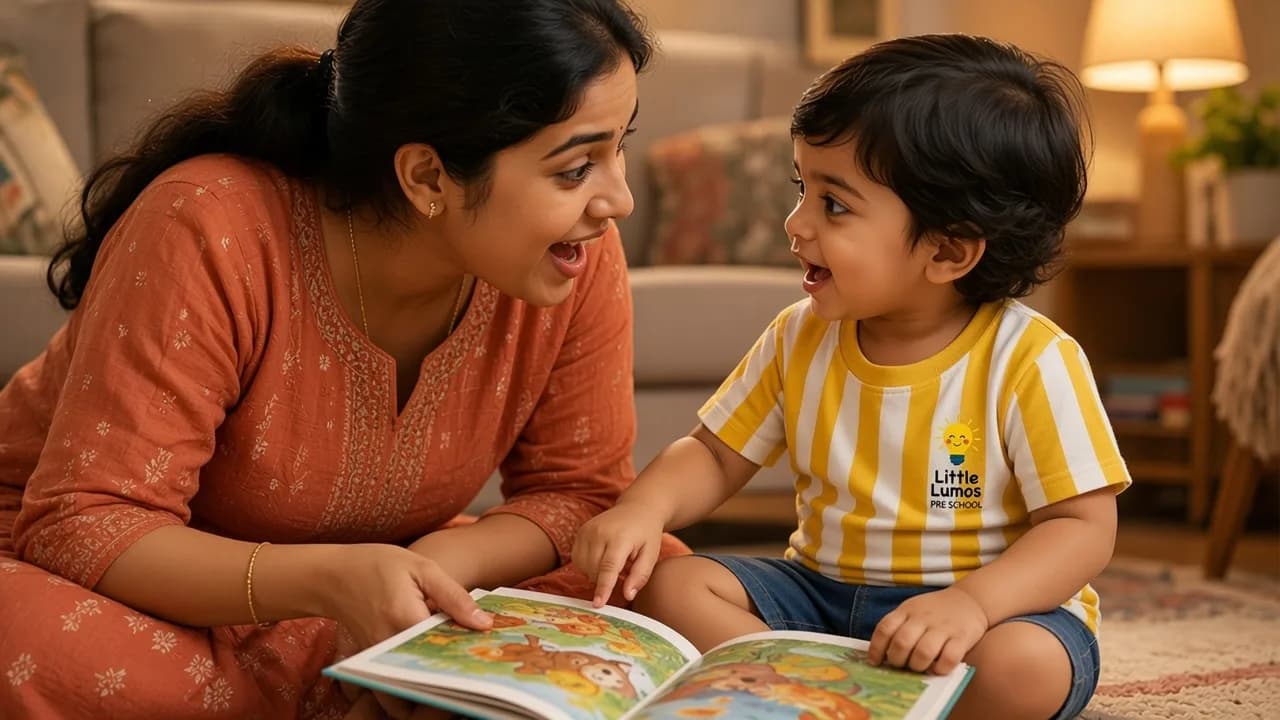
Read the same book again. And again. Repetition is how words stick. The fourteenth reading is doing more than the first.
Ask fewer questions. "What colour is this? What's this? What does the cow say?" is a viva. Comment instead of quizzing and you will get more talk back.
A word about screens and language. Passive video does not teach language to children of this age, no matter how educational it claims to be. Language is built in the back-and-forth: your child does something, you respond, they respond to that. A video does not wait for them. A video call with a grandparent, where someone is genuinely responding, is a different thing altogether and is fine.
The things worth acting on
Most late talkers catch up. A few benefit enormously from early help, and the help is gentle, play-based and undramatic. These are the points at which it is reasonable to stop waiting and ask:
No babbling by around 12 months. No single words by around 16 months. No two-word phrases by around two years. Not responding to their name, not pointing at things to show you, or not making eye contact. Very little interest in communicating with people at all, by any method. Speech that even close family cannot understand by three. And at any age, losing words or skills your child previously had, which always warrants a prompt conversation.
Ask for a hearing check first. Before anything else. Hearing is the most common and most fixable cause of delayed speech, and fluid behind the eardrum after repeated coughs and colds is easy to miss because it causes no pain and comes and goes. A child who is hearing everything through a blanket will, quite logically, be slow to talk. This one test rules out a great deal.
On "he'll talk when he's ready"
You will hear it, usually from someone who loves you. And they are right much of the time, which is exactly what makes it difficult.
But a speech assessment costs you an afternoon and some anxiety, and it either reassures you or starts something useful early, at the age when it works best. Waiting costs time you cannot get back. If the worry has been sitting with you for a few months, that is reason enough. You do not need permission or proof.
Nobody has ever regretted checking too early.
Why early intervention matters covers what that actually involves, and it is far less alarming than most parents expect.
Try this this week
Pick one routine that happens every single day, bath time is ideal, and turn it into a talking slot. Narrate everything, pause often, and add one word to whatever your child offers. Same time, same activity, every day. Small and daily beats big and occasional.
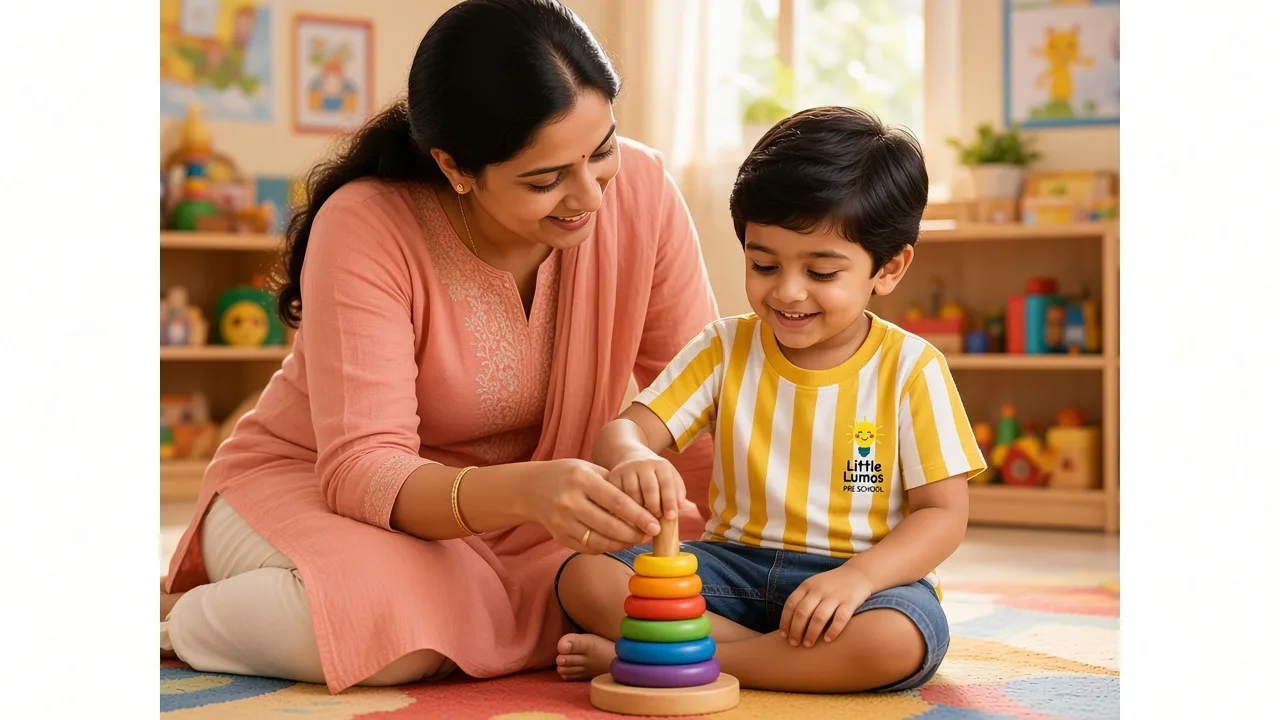
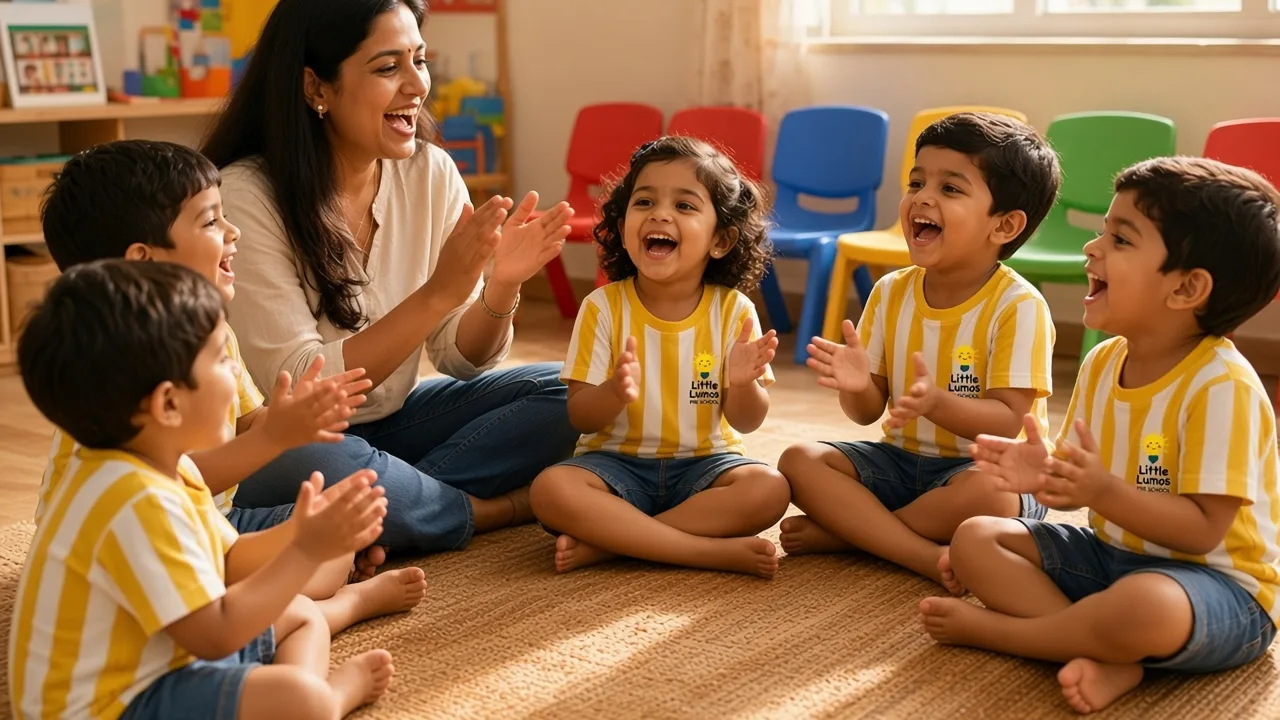
At Little Lumos in Siddharth Nagar, language runs through the whole day rather than sitting in a slot: stories, rhymes in Telugu and English, songs, and a great deal of unhurried conversation with adults who wait for an answer. We treat every child as a capable communicator long before they are a fluent one.
Interactive tools
Check your child's stage
Typical milestones age by age, everyday habits that grow talking, and the signs worth raising with a professional.
Interactive milestone checker
What's Typical at Each Age
Pick your child's age and tick what they can already do. These are guides, not deadlines, children sprint ahead in one area while taking their time in another.
Understands
Says
0 of 6 ticked for 12–18 months
Boost talking at home
Simple, Powerful Everyday Habits
Narrate your day
Talk through what you're doing as you do it, 'now we're washing the red cup'. This pours a steady stream of words and meaning into your child's world, the single best thing for building language.
Gentle red flags
When a Chat With a Professional Helps
- No babbling or gesturing (pointing, waving) by around 12 months
- No words by 16–18 months
- Not putting two words together by age 2
- Hard for family to understand by age 3
- Doesn't seem to understand simple instructions
- Loses speech or social skills they once had, at any age
Keep in mind
Four Reassuring Truths
A wide normal range
Children reach language milestones at very different times. Late talking is common and often catches up on its own.
Understanding comes first
Children grasp far more than they can say, up to five times more words between ages one and two. Comprehension leads.
You are the best tool
Everyday talking, singing, and reading build language far better than any app or flashcard. Connection is the curriculum.
Two languages is a gift
Growing up bilingual doesn't cause delay. A strong mother tongue actually supports learning English later.
A Preschool Where Language Grows All Day
At Little Lumos, conversation, stories, rhymes, and songs fill every day. Come see our Reggio Emilia inspired, language-rich classrooms in Siddharth Nagar, Kakinada.
Sources
- Language and Speech Development Milestones, Centers for Disease Control and Prevention
- Language Delays in Toddlers: Information for Parents, American Academy of Pediatrics (HealthyChildren.org)
At Little Lumos in Kakinada, this is part of everyday practice. Read more about how we support emotional development, or why families choose Little Lumos, or book a campus visit.
People Also Ask
Quick answers to the questions parents ask most.
Many children say their first words around 12 months, use several single words by 18 months, and begin putting two words together, like 'more milk', between 18 and 24 months. By age 2 to 3, most move into short sentences and can be understood by familiar adults much of the time. Remember there is a very wide normal range, and children understand far more than they can say.