The Hundred Languages of Children: The Heart of the Reggio Emilia Approach

Little Lumos Team
Reviewed by Dr. K. Lakshmi Lalithya, Founder & Principal
We share insights, stories, and practical tips for mindful parenting, straight from our vibrant learning community.
A child has a hundred ways of thinking, playing and expressing — but traditional schooling keeps only a few. Discover what the hundred languages of children really means, why it matters for your child's development, and how Little Lumos in Kakinada brings it to life every day.
- What Does the Hundred Languages Actually Mean?
- The Ninety-Nine That Get Stolen
- Why the Hundred Languages Matter for Your Child
- The Atelier: A Home for the Hundred Languages
- How We Honour Every Language at Little Lumos
- What Parents Can Do at Home
- A Purple Tree Is Not a Mistake
- See the Hundred Languages in Action
- Interactive tools

There is a poem that hangs, in spirit, on the wall of every Reggio Emilia inspired school in the world. It was written by Loris Malaguzzi, the founder of the approach, and it begins with a striking claim: the child has a hundred languages. A hundred ways of thinking, of playing, of speaking. A hundred ways of listening, of marvelling, of loving. And then comes the heartbreak of the poem — that school and culture too often steal ninety-nine of those languages away.
This idea, the hundred languages of children, is not a poetic flourish. It is the beating heart of the Reggio Emilia philosophy, and once you understand it, you will never look at your child's scribbles, block towers, or pretend games the same way again. This article explains what the hundred languages really means, why it matters so deeply for your child, and how we keep all hundred alive at Little Lumos in Kakinada.
What Does the Hundred Languages Actually Mean?
The number one hundred is not literal. It is a way of saying countless. Malaguzzi was making a profound point about how young children come to understand their world. Long before a child can read or write, they are already thinking in rich, complex ways — and they express that thinking through every channel available to them.
A toddler does not need words to investigate gravity; they drop a spoon from the high chair again and again, watching, predicting, and delighting. A four-year-old does not need a vocabulary for grief to process the loss of a pet; they may draw it, act it out, or build a tiny grave from twigs. Drawing, painting, sculpting, building, dancing, singing, role-play, gesture, and storytelling are not breaks from real learning. They are real learning. They are languages, every bit as valid as speech and writing.
The Ninety-Nine That Get Stolen
Here is the uncomfortable truth Malaguzzi wanted us to face. Conventional schooling, with the best of intentions, tends to narrow a child's hundred languages down to just one or two. Sit still. Hold the pencil this way. Colour inside the lines. Give me the one correct answer. Over time, the message sinks in: the only thinking that counts is the kind that happens on paper, at a desk, in words and numbers.
The child who thinks brilliantly in movement is told to stop fidgeting. The child who reasons through building is told to pack away the blocks and do real work. Slowly, the other languages fall silent — not because the child lost them, but because no one valued them. Reggio educators refuse to let this happen. We believe a child who keeps all hundred languages grows into a more creative, flexible, and confident thinker.
Why the Hundred Languages Matter for Your Child
Protecting these many languages is not about producing little artists or performers. It is about nurturing the whole brain and the whole child. Here is what happens when a child is free to express ideas in many forms.
- Deeper understanding. When a child explains an idea through clay and then through words, they understand it from two angles, not one. Translating between languages strengthens thinking.
- Emotional health. A child who cannot yet say I feel left out can paint it or play it. Expression prevents big feelings from becoming overwhelming.
- Creativity and problem-solving. Children who habitually approach problems in multiple ways become adults who find solutions others miss.
- Confidence. Every child has a language they shine in. Honouring all of them means every child gets to feel capable, not just the early talkers and writers.
- A genuine love of learning. When learning feels like expression rather than compliance, children come to school eager rather than reluctant.
The Atelier: A Home for the Hundred Languages
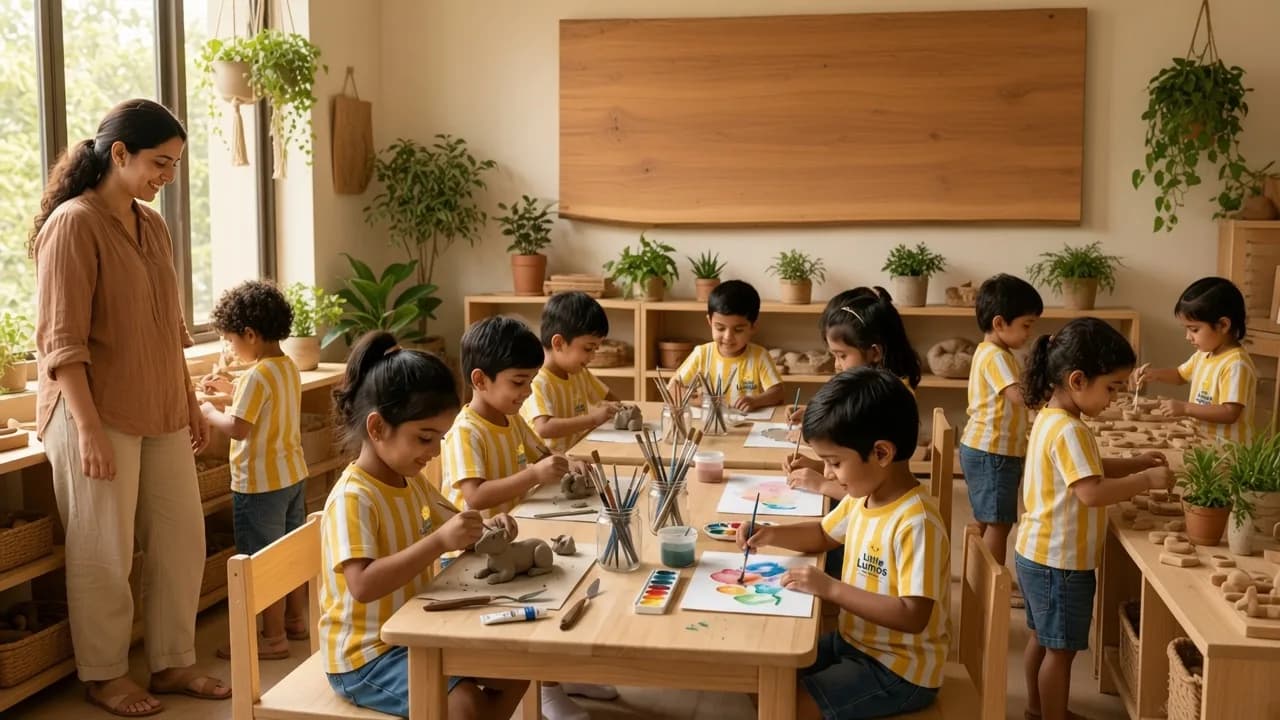
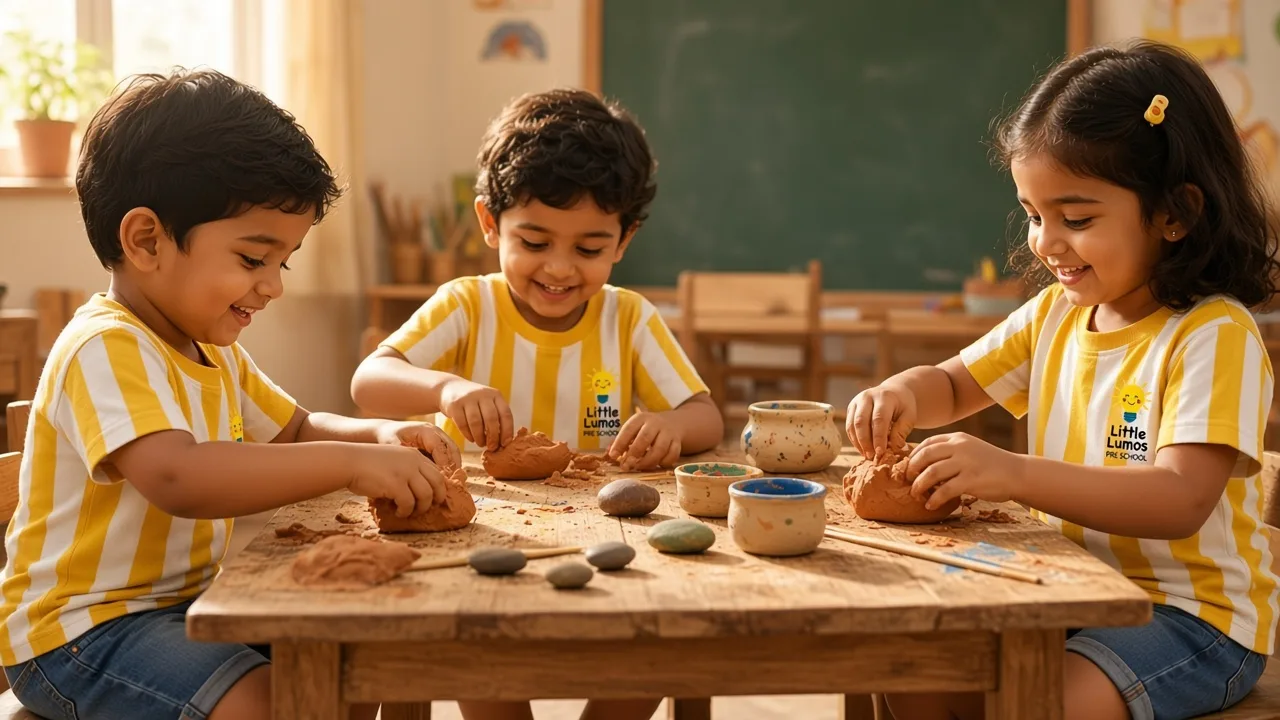
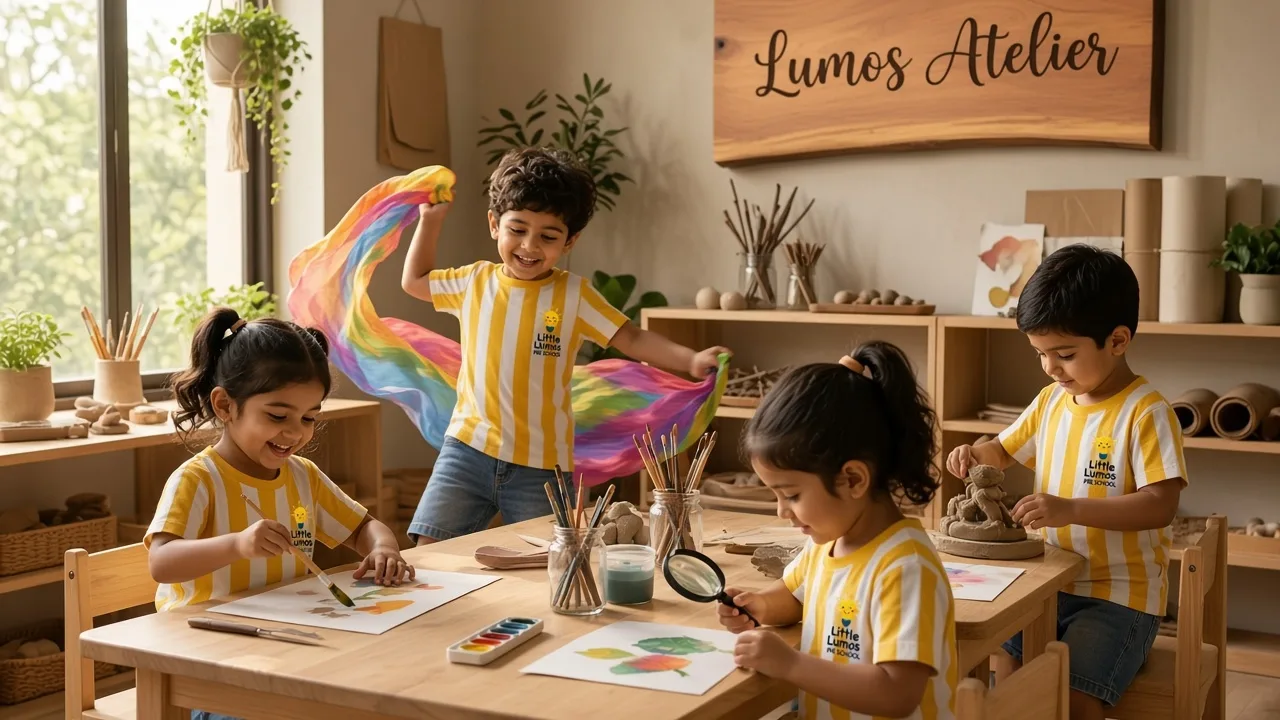
In Reggio schools there is a special studio space called the atelier, and it is where the hundred languages come most vividly to life. The atelier is stocked not with worksheets but with real, open-ended materials — paint, clay, wire, paper, natural objects, light, fabric, and recycled treasures.
At Little Lumos, our atelier is one of the most loved spaces in the school. A child might spend a long, absorbed morning mixing exactly the shade of orange they remember from a sunset, or bending wire into the shape of the spider they found in the garden. There is no template to copy and no single correct result. The materials become tools for thinking, and the act of creating becomes the act of understanding. We are never asking what is it. We are asking tell me about what you made — and the answers are often astonishing.
How We Honour Every Language at Little Lumos
Keeping the hundred languages alive is a daily, deliberate practice. It shows up in countless ways across our Kakinada campus.
- We offer real materials and open-ended invitations rather than fill-in-the-blank worksheets.
- We give children long, unhurried stretches of time, because deep expression cannot be rushed into a thirty-minute slot.
- We treat movement, music, and dramatic play as serious learning, not as rewards for finishing real work.
- We document children's creations — with photos, quotes, and displays — so their many languages are seen and valued by the whole community.
- We ask open questions that invite children to think out loud rather than guess the answer in our heads.
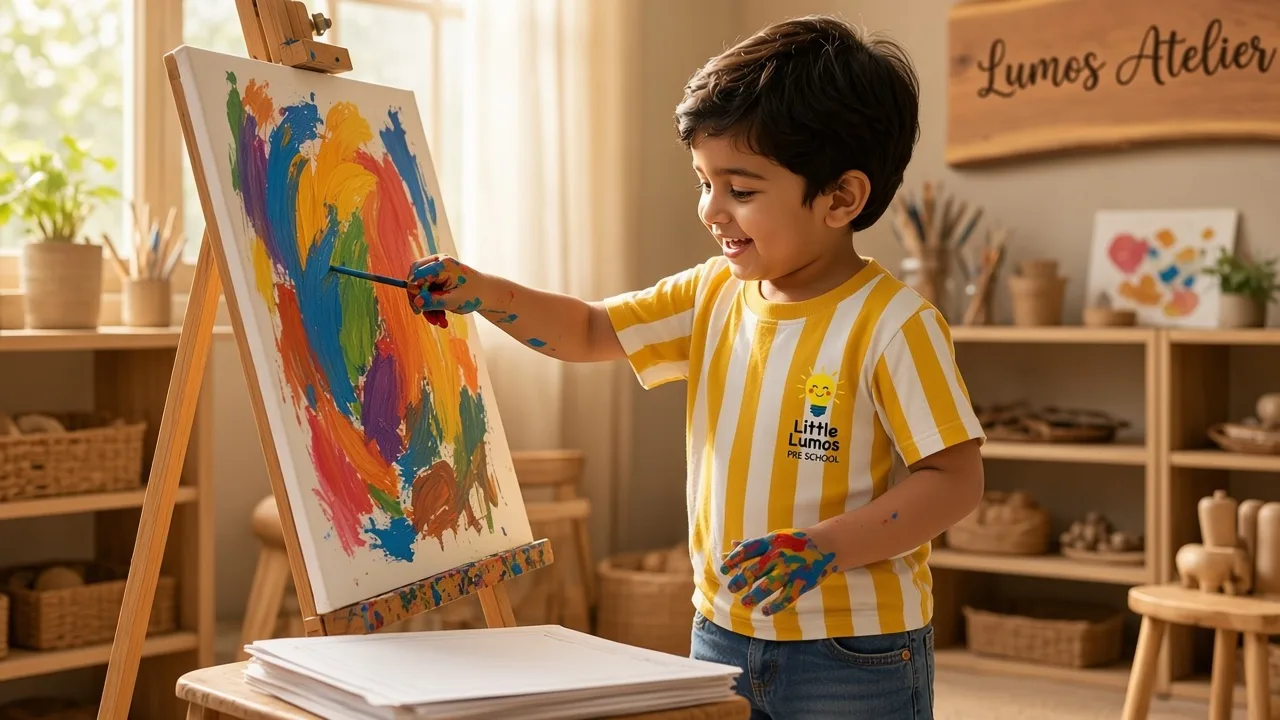
- We resist correcting a purple tree or a six-legged cat, because that is a child seeing the world in their own extraordinary way.
What Parents Can Do at Home
You do not need an art studio or expensive supplies to keep your child's hundred languages thriving at home. You need curiosity and a little restraint. Here are simple, powerful habits any family in Kakinada can adopt.
- Offer open-ended materials — old boxes, fabric scraps, crayons, clay, water, and natural objects — and let your child decide what to make.
- Ask tell me about it instead of guessing or labelling what your child has created.
- Display their work at home, at their eye level, to show that their ideas matter.
- Resist fixing or improving their drawings and creations. The wonky, lopsided result is theirs, and that is the point.
- Make room for movement, music, and pretend play, and join in without taking over.
- Notice which language your child reaches for naturally, and feed it generously.
A Purple Tree Is Not a Mistake
It is worth returning to that image, because it captures the whole philosophy. When a child paints a purple tree, the instinct of many adults is to gently correct it — trees are green, sweetheart. But in the Reggio view, that purple tree is not an error to fix. It is a window into a mind that is still gloriously free, a child who has not yet learned that there is only one acceptable answer.
Protecting that freedom is one of the greatest gifts we can give a child in their earliest years. The skills of reading, writing, and arithmetic will come, and they come beautifully to children who arrive curious and confident. But the hundred languages — the creativity, the expressiveness, the courage to think differently — are far harder to teach later if they are silenced now.
See the Hundred Languages in Action
At Little Lumos, Kakinada's first Reggio Emilia inspired preschool, the hundred languages of children are not a slogan on a brochure. They are what you will see, hear, and feel the moment you walk through our doors in Siddharth Nagar — children painting their ideas, building their questions, dancing their stories, and speaking in every language a young mind possesses.
We welcome children aged two to six, and we would love to show you what it looks like when none of those hundred languages are taken away. Come and visit. Watch your child discover that here, every way they think is a way that counts.
Interactive tools
Explore the languages
A few of the hundred, what happens when they get taken away, and how to keep them alive at home.
First, the idea
What Does the Hundred Languages Actually Mean?
The number one hundred is not literal. It is a way of saying countless. Malaguzzi was making a profound point about how young children come to understand their world. Long before a child can read or write, they are already thinking in rich, complex ways, and they express that thinking through every channel available to them. A toddler does not need words to investigate gravity; they drop a spoon from the high chair again and again, watching, predicting, and delighting. Drawing, painting, sculpting, building, dancing, singing, role-play, gesture, and storytelling are not breaks from real learning. They are real learning.
Interactive explorer
Explore a Few of the Hundred Languages
Tap a language to see how children use it to think.
Painting & drawing
A child who cannot yet say I feel left out can paint it in heavy greys, working the feeling out on paper before they ever have the words.
The uncomfortable truth
The Ninety-Nine That Get Stolen
Conventional schooling, with the best of intentions, tends to narrow a child's hundred languages down to just one or two. Sit still. Hold the pencil this way. Colour inside the lines. Give me the one correct answer. Over time, the message sinks in: the only thinking that counts is the kind that happens on paper, at a desk, in words and numbers.
Reggio educators refuse to let this happen. We believe a child who keeps all hundred languages grows into a more creative, flexible, and confident thinker.
Why it matters
What Happens When a Child Keeps All Hundred
Deeper understanding
When a child explains an idea through clay and then through words, they understand it from two angles, not one. Translating between languages strengthens thinking.
Emotional health
A child who cannot yet say I feel left out can paint it or play it. Expression prevents big feelings from becoming overwhelming.
Creativity & problem-solving
Children who habitually approach problems in multiple ways become adults who find solutions others miss.
Confidence for every child
Every child has a language they shine in. Honouring all of them means every child gets to feel capable, not just the early talkers and writers.
A genuine love of learning
When learning feels like expression rather than compliance, children come to school eager rather than reluctant.
A home for the languages
The Atelier
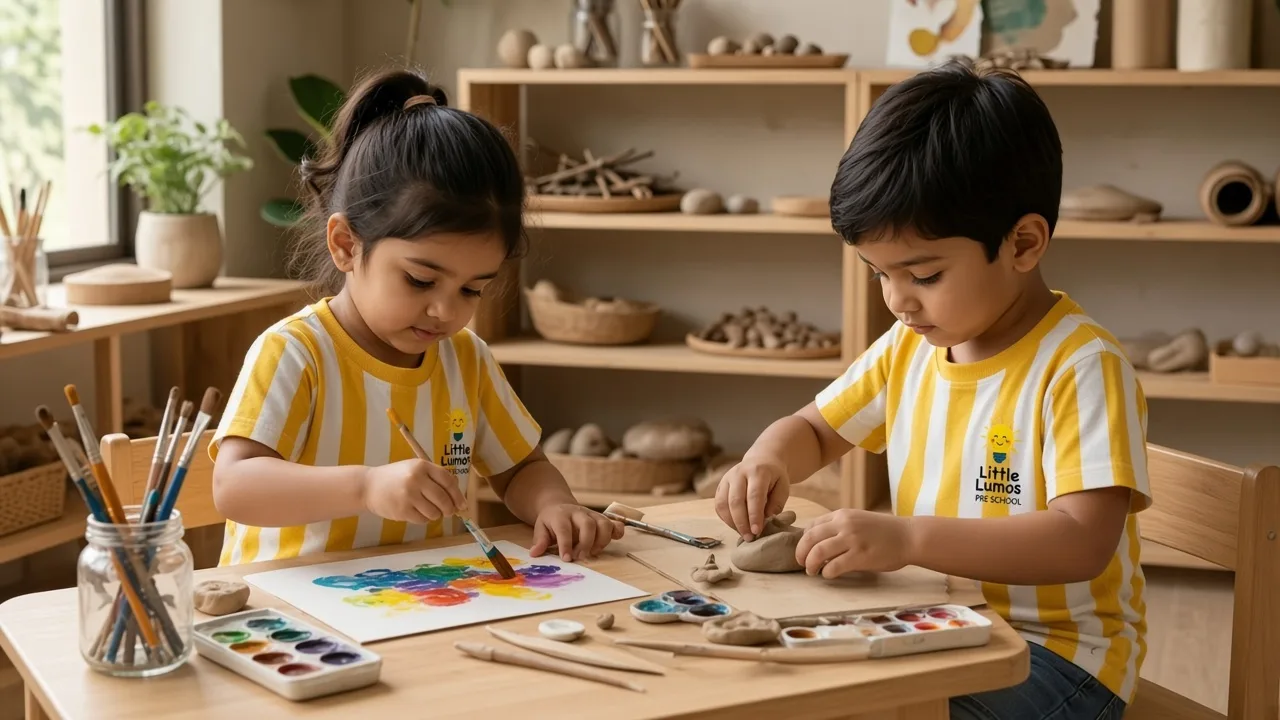
In Reggio schools there is a special studio space called the atelier, and it is where the hundred languages come most vividly to life. The atelier is stocked not with worksheets but with real, open-ended materials, paint, clay, wire, paper, natural objects, light, fabric, and recycled treasures. At Little Lumos, a child might spend a long, absorbed morning mixing exactly the shade of orange they remember from a sunset, or bending wire into the shape of the spider they found in the garden. There is no template to copy and no single correct result. We are never asking what is it. We are asking tell me about what you made, and the answers are often astonishing.
Try this at home
Keep the Hundred Languages Alive at Home
You do not need an art studio or expensive supplies. You need curiosity and a little restraint.
See the Hundred Languages in Action
At Little Lumos, the hundred languages of children are not a slogan on a brochure. They are what you will see, hear, and feel the moment you walk through our doors in Siddharth Nagar, children painting their ideas, building their questions, and speaking in every language a young mind possesses. We welcome children aged 2 to 6.
At Little Lumos in Kakinada, this is part of everyday practice. Read more about the atelier at the heart of our curriculum, or children's work from our studio, or book a campus visit.
People Also Ask
Quick answers to the questions parents ask most.
It is a poem and an idea from Loris Malaguzzi, founder of the Reggio Emilia approach. It means children have many ways to think, express ideas and understand the world: drawing, painting, clay, building, movement, music, story and play, not only speaking and writing.