The Reggio Emilia Approach: A Complete Guide for Parents in Kakinada

Little Lumos Team
Reviewed by Dr. K. Lakshmi Lalithya, Founder & Principal
We share insights, stories, and practical tips for mindful parenting, straight from our vibrant learning community.
What is the Reggio Emilia approach, and why is it transforming early education? This complete guide explains the philosophy, principles, and daily practice behind Little Lumos — Kakinada's first Reggio Emilia inspired preschool — so you can decide if it is right for your child.
- Where the Reggio Emilia Approach Came From
- The Image of the Child: The Big Idea
- The Core Principles of Reggio Emilia
- The Hundred Languages of Children
- The Environment as the Third Teacher
- The Role of the Teacher
- The Role of Parents and Community
- What a Reggio Day Looks Like at Little Lumos
- Why Reggio Works: What the Research Says
- Is the Reggio Emilia Approach Right for Your Child?
- Experience It at Little Lumos, Kakinada
- Interactive tools

If you have been researching preschools in Kakinada, you have almost certainly come across the phrase Reggio Emilia. It sounds impressive, perhaps a little mysterious, and most school websites describe it in a single polished sentence before moving on. But the Reggio Emilia approach is far more than a marketing label. It is one of the most respected early childhood education philosophies in the world, and at Little Lumos it shapes every corner, every conversation, and every choice we make for your child.
This guide is the resource we wish every parent had before choosing a preschool. By the end, you will understand where the Reggio Emilia approach came from, what it actually believes about children, how it looks in a real classroom, and why families across Kakinada are choosing it for their little ones.
Where the Reggio Emilia Approach Came From
The story begins in the small city of Reggio Emilia in northern Italy, in the rubble of the years following the Second World War. Parents in the region made a remarkable decision: they wanted to rebuild not just their homes, but a new kind of education for their children — one that would never again produce blind obedience. They began by literally selling bricks, an old tank, and a few army trucks left behind by the war to fund their first school.
A young teacher named Loris Malaguzzi heard about these parents and cycled over to see what they were doing. He stayed for the rest of his life. Over the following decades, Malaguzzi and the educators of Reggio Emilia developed an approach to early learning so powerful that, in 1991, Newsweek named the city's infant-toddler centres among the best in the world. Today, educators travel from every continent to study what these Italian schools discovered. Little Lumos brings that same philosophy, thoughtfully adapted, to families here in Kakinada.
The Image of the Child: The Big Idea
Everything in Reggio Emilia flows from one foundational belief, what Malaguzzi called the image of the child. In most traditional schooling, the child is treated as an empty vessel — a cup waiting to be filled with facts by an all-knowing adult. The Reggio approach rejects this completely.
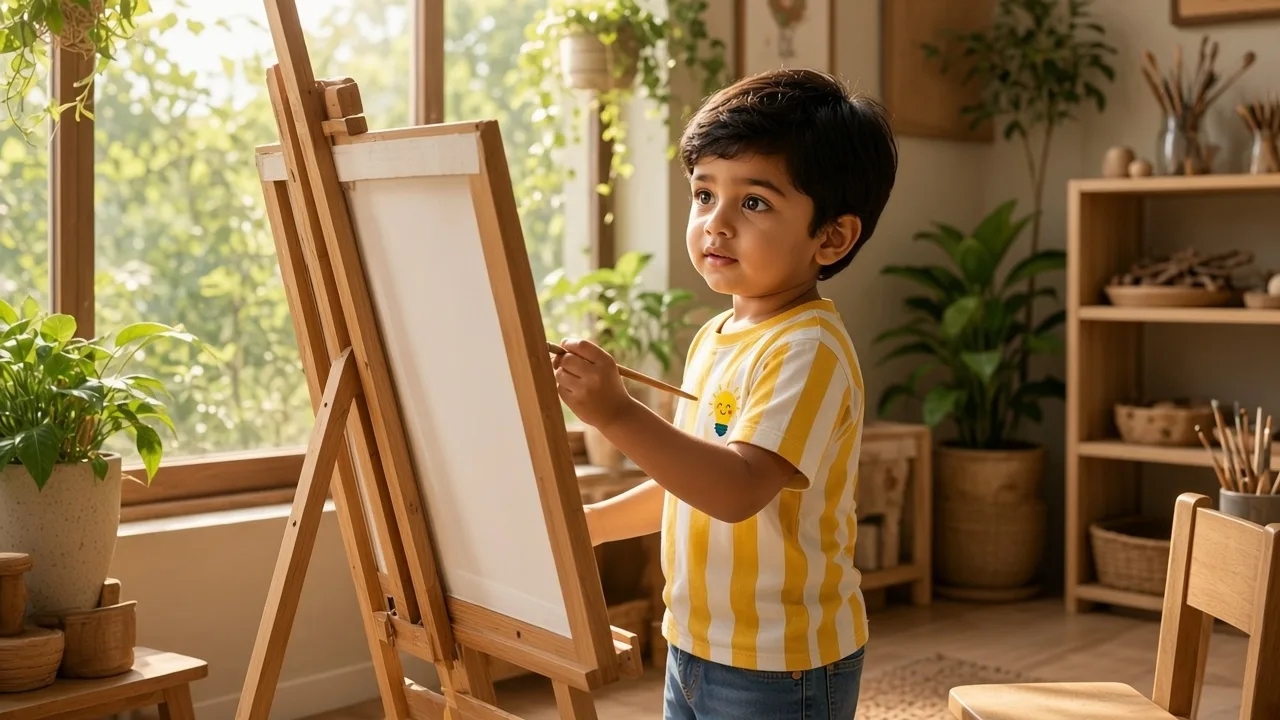
Instead, it sees every child as strong, capable, curious, and full of potential from birth. A child is not a future person waiting to begin. A child is a competent thinker, a researcher, and a citizen right now. When you believe this about a child, everything changes. You stop pouring information into them and start listening to them. You stop directing and start collaborating. You begin to trust that a two-year-old exploring a puddle is doing serious intellectual work.
This single shift — from filling children up to drawing children out — is the heart of why Reggio classrooms feel so alive.
The Core Principles of Reggio Emilia
The philosophy rests on a handful of interconnected principles. Each one supports the others, and together they create a learning culture rather than a curriculum to be ticked off.
- The child as protagonist. Children are active constructors of their own knowledge, not passive recipients. Learning is something they do, not something done to them.
- The hundred languages of children. Children express understanding in countless ways — drawing, sculpting, building, dancing, dramatic play, music, and words. Reggio honours all of them.
- The environment as the third teacher. The physical space is designed so carefully that it teaches alongside adults, inviting exploration, calm, and wonder.
- The teacher as researcher and guide. Educators observe, document, and walk beside children rather than standing in front of them with answers.
- Documentation as a tool for learning. Children's words, photos, and work are recorded and revisited, making thinking visible to children, parents, and teachers.
- Projects driven by curiosity. Learning unfolds through long, in-depth investigations that grow out of what children genuinely wonder about.
- Parents and community as partners. Families are not visitors to the school. They are essential collaborators in their child's learning journey.
The Hundred Languages of Children
Malaguzzi wrote a famous poem about the hundred languages of children — the idea that a child has a hundred ways of thinking, playing, and speaking, and that conventional schooling too often strips away ninety-nine of them, leaving only reading and writing at a desk.
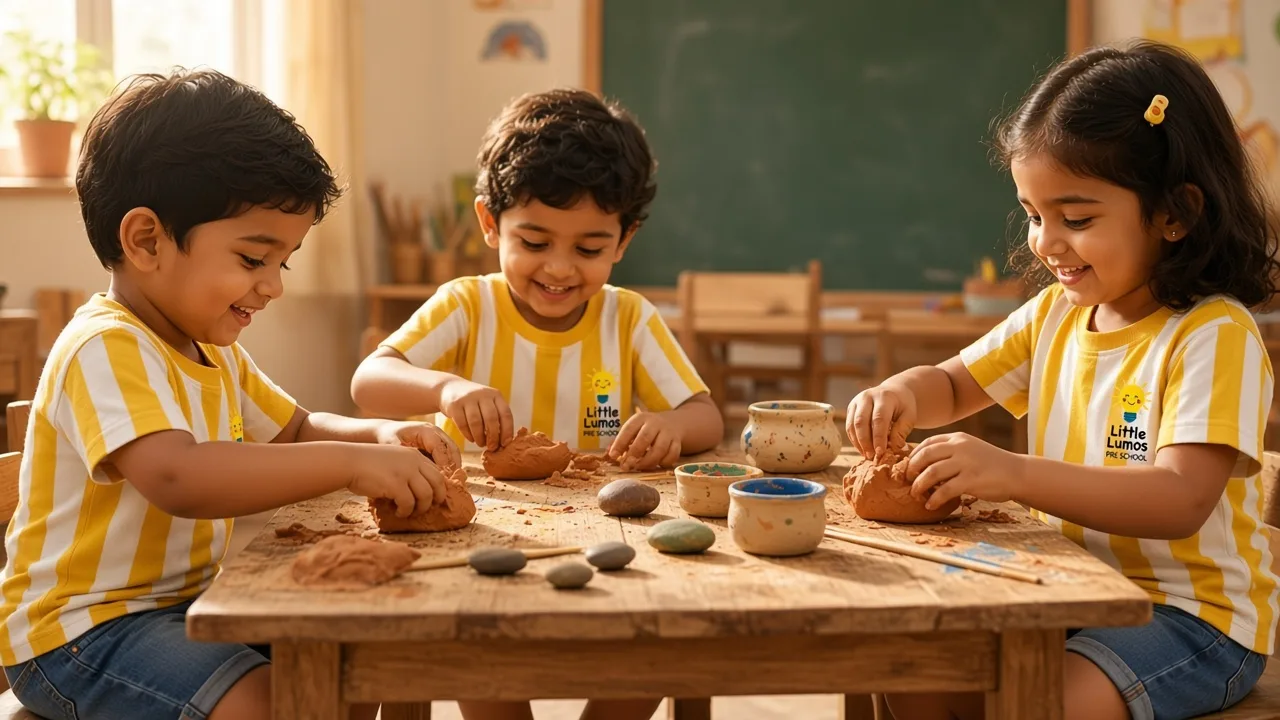
At Little Lumos, we protect all hundred. A child who cannot yet explain a feeling in words may paint it in deep blues and reds. A child puzzled by how rain works might build a river out of blocks before they ever write the word water. When we let children express ideas through clay, movement, light, storytelling, and song, we are not adding fun extras to a serious curriculum. We are recognising that these are serious ways of thinking. The clay, the paint, and the music are languages, and fluency in them builds the creativity and confidence that last a lifetime.
The Environment as the Third Teacher
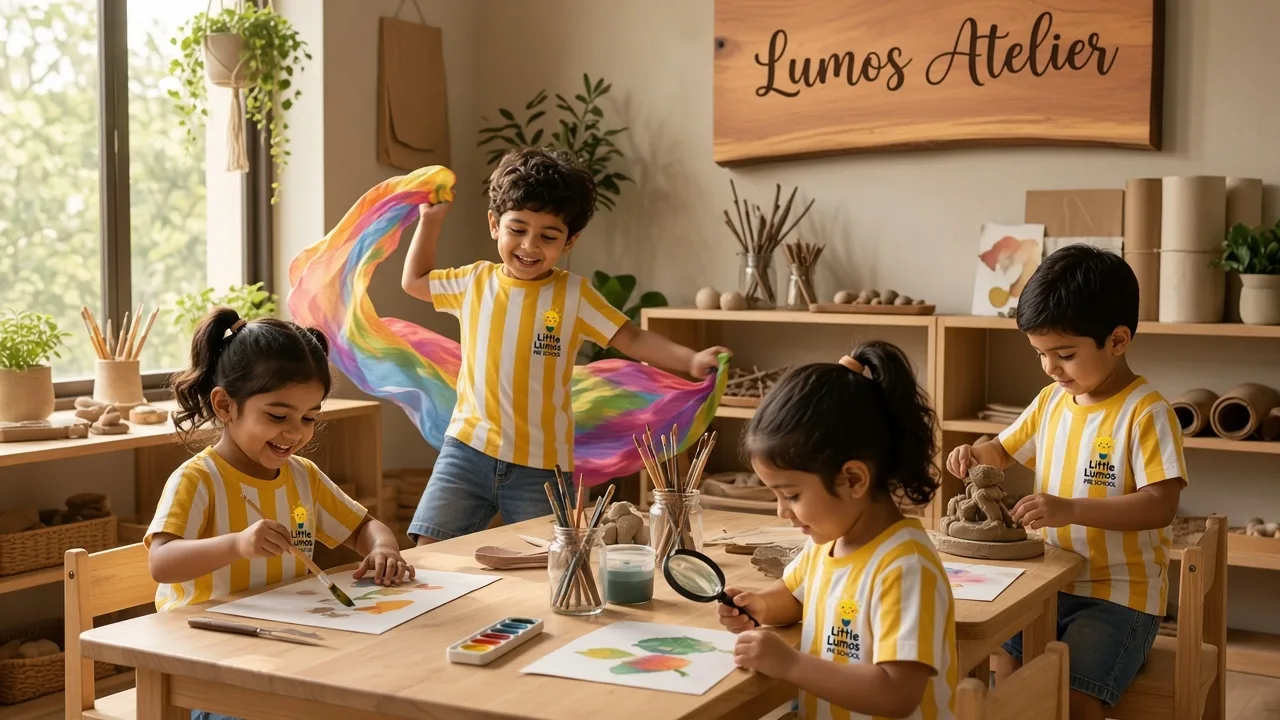
Walk into a Reggio-inspired classroom and you will immediately sense something different. There is natural light, real materials, plants, mirrors, and child-height shelves. Nothing is cluttered or plastic-bright for its own sake. Every object has been chosen to invite curiosity.
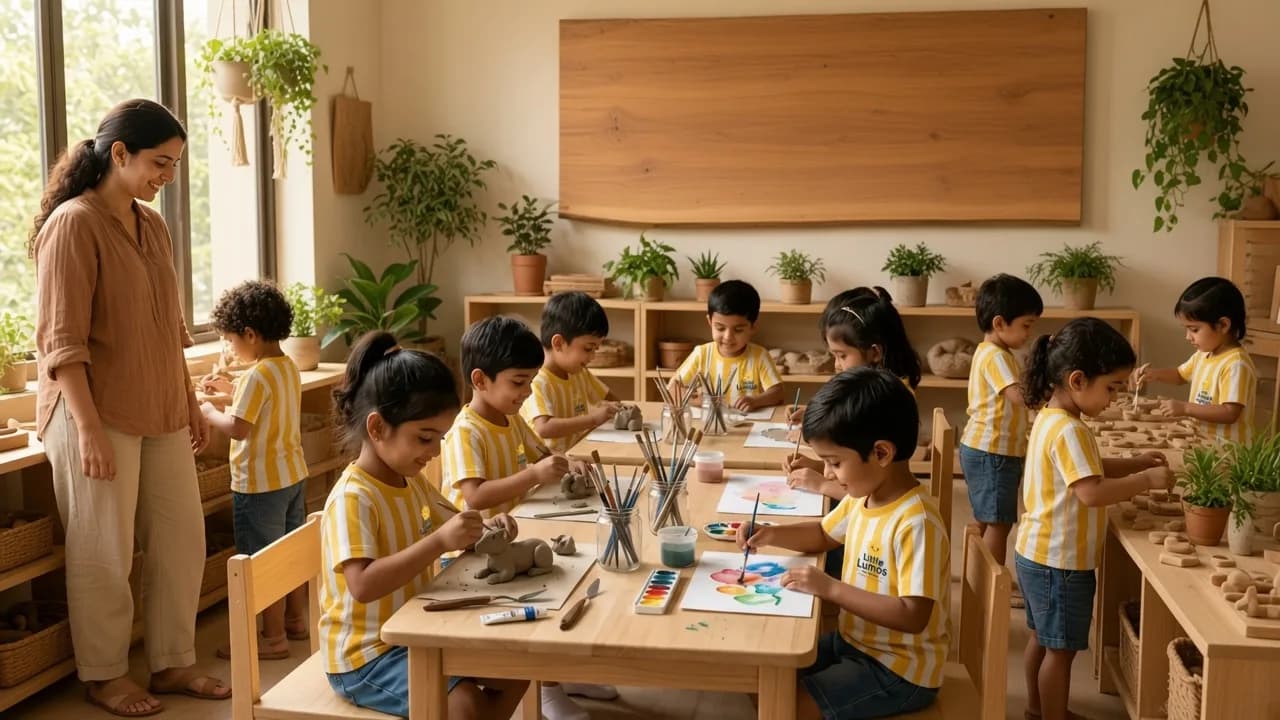
Reggio educators call the environment the third teacher because, after the children and the adults, the space itself does the work of teaching. A basket of pinecones, shells, and smooth stones invites sorting and comparing. A light table turns colour and transparency into an experiment. A cosy reading nook tells a child it is safe to slow down. At Little Lumos, our atelier, library, nature corner, and snuggle spaces are all designed with this intention. The room is never just a backdrop. It is an active partner in your child's discovery.
The Role of the Teacher
If children are the protagonists, what does a teacher actually do? A great deal — but rarely the lecturing we associate with traditional school.
A Reggio teacher is a careful observer, a co-researcher, and a provoker of curiosity. They watch closely to understand what each child is interested in, then design experiences that stretch that interest further. They ask open questions like tell me about what you made, rather than closed ones with a single right answer. They resist the urge to rush in with solutions, because they know that the struggle to figure something out is exactly where learning lives.
This is far harder than simply delivering a worksheet, and it is why our educators at Little Lumos are trained to listen first and teach second. Their job is not to fill the silence with answers, but to protect the curiosity that produces good questions.
The Role of Parents and Community
In the Reggio philosophy, a child's education is a partnership between school, family, and community. Parents are warmly involved — not as occasional guests at an annual function, but as genuine collaborators who share insights about their child and take part in the learning story.
We believe a child thrives when the people who love them are pulling in the same direction. That is why we keep communication open, share documentation of your child's days, and welcome your observations from home. When you tell us your child has become fascinated by ants in the garden, that becomes fuel for a classroom investigation. The home and the school become one continuous, encouraging world.
What a Reggio Day Looks Like at Little Lumos
Parents often ask what actually happens on a typical morning. There is no rigid bell-to-bell timetable of disconnected subjects. Instead, the day flows with a gentle, predictable rhythm that still leaves room for the unexpected.
- Children arrive to a warm welcome and time to settle into self-chosen play.
- Morning gatherings build a sense of community through songs, stories, and conversation.
- Long, unhurried stretches of project work and exploration let ideas deepen.
- The atelier invites painting, clay, collage, and building as ways to think.
- Outdoor and sensory play connect children with nature and movement.
- Snack and rest happen in a calm, unhurried, screen-free environment.
- Teachers document the day — photos, quotes, and work — to revisit together.
Notice what is missing: no screens, no rows of desks, no pressure to produce identical worksheets. Notice what is present: time, choice, conversation, and real materials.
Why Reggio Works: What the Research Says
The Reggio Emilia approach is not only beautiful in theory. Decades of observation and research into high-quality, play-based early education consistently link this kind of learning with stronger outcomes: deeper critical thinking, richer language, greater creativity, better collaboration, and notably stronger social and emotional skills.
The reason is intuitive once you understand the philosophy. Children who are trusted to ask questions become better questioners. Children who are given real choices become better decision-makers. Children whose emotions are named and respected grow into emotionally intelligent people. A child who learns that their ideas matter carries that confidence into primary school and far beyond.
Is the Reggio Emilia Approach Right for Your Child?
Reggio is a wonderful fit for families who want their child to love learning, not merely tolerate it; who value creativity and confidence as much as letters and numbers; and who believe early childhood should be a time of wonder rather than worksheets. It suits curious children and quiet children, energetic children and gentle ones — because it meets each child where they are rather than forcing them into a single mould.
If you are searching for a preschool that drills your two-year-old in rote memorisation and sends home stacks of completed worksheets, Reggio will look unfamiliar. But if you want your child to walk out of preschool genuinely curious, kind, expressive, and ready for school in the deepest sense, you will feel right at home.
Experience It at Little Lumos, Kakinada
Words on a page can only take you so far. The real magic of the Reggio Emilia approach is something you feel the moment you step into a classroom full of absorbed, happy, busy children.
Little Lumos is Kakinada's first Reggio Emilia inspired preschool, located in Siddharth Nagar, welcoming children aged two to six. We would love to show you what curiosity-led, screen-free, joyful learning looks like in person. Come visit, watch a real morning unfold, and ask us anything. Your child is born curious, capable, and full of potential. Our job is simply to protect that — and help it shine.
Interactive tools
Explore the approach in depth
Where it came from, the principles behind it, what a day actually looks like, and whether it suits your child.
The story
Where the Reggio Emilia Approach Came From
Tap through the timeline to follow the journey from post-war Italy to Kakinada.
Born from the rubble of war
In the small city of Reggio Emilia in northern Italy, parents made a remarkable decision after the Second World War. They wanted a new kind of education that would never again produce blind obedience. They funded their first school by literally selling bricks, an old tank, and a few army trucks left behind by the war.
The big idea
The Image of the Child
Everything in Reggio Emilia flows from one foundational belief, what Malaguzzi called the image of the child. Tap each view to see the difference.
The Reggio approach sees every child as strong, capable, curious, and full of potential from birth. A child is not a future person waiting to begin, they are a competent thinker, a researcher, and a citizen right now. When you believe this, everything changes. You stop pouring information in and start listening. You begin to trust that a two-year-old exploring a puddle is doing serious intellectual work.
The foundations
The Core Principles of Reggio Emilia
The philosophy rests on a handful of interconnected principles. Together they create a learning culture rather than a curriculum to be ticked off. Tap each one to explore.
Children are active constructors of their own knowledge, not passive recipients. Learning is something they do, not something done to them.
The hundred languages of children
Malaguzzi wrote a famous poem about the hundred languages of children, the idea that a child has a hundred ways of thinking, playing, and speaking, and that conventional schooling too often strips away ninety-nine of them. At Little Lumos, we protect all hundred. A child who cannot yet explain a feeling in words may paint it in deep blues and reds. A child puzzled by how rain works might build a river out of blocks before they ever write the word water. The clay, the paint, and the music are languages, and fluency in them builds the creativity and confidence that last a lifetime.
The third teacher
The Environment as the Third Teacher
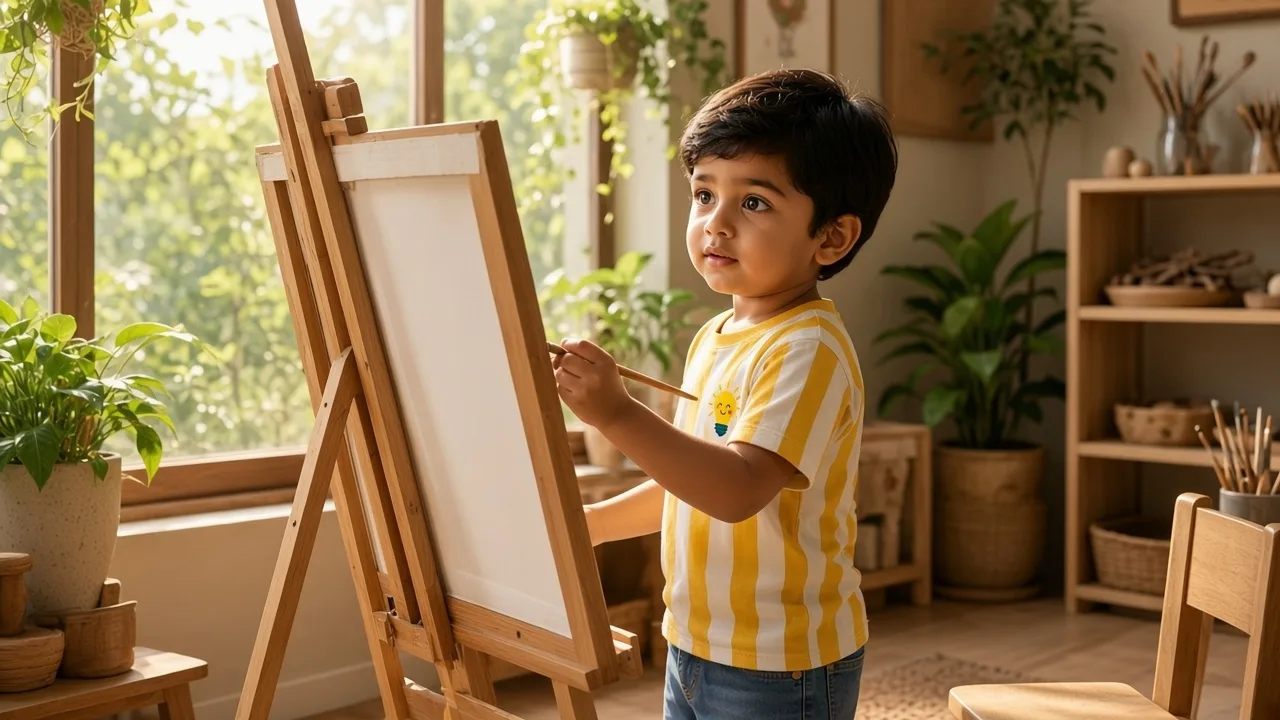
Walk into a Reggio-inspired classroom and you will immediately sense something different. There is natural light, real materials, plants, mirrors, and child-height shelves. Nothing is cluttered or plastic-bright for its own sake. Every object has been chosen to invite curiosity. Reggio educators call the environment the third teacher because, after the children and the adults, the space itself does the work of teaching. A basket of pinecones, shells, and smooth stones invites sorting and comparing. A light table turns colour and transparency into an experiment. A cosy reading nook tells a child it is safe to slow down.
The role of the teacher
A Reggio teacher is a careful observer, a co-researcher, and a provoker of curiosity. They watch closely to understand each child's interests, then design experiences that stretch them further. They ask open questions like tell me about what you made, rather than closed ones with a single right answer. They resist rushing in with solutions, because the struggle to figure something out is exactly where learning lives.
The role of parents
A child's education is a partnership between school, family, and community. Parents are genuine collaborators who share insights and take part in the learning story. When you tell us your child has become fascinated by ants in the garden, that becomes fuel for a classroom investigation. The home and the school become one continuous, encouraging world.
A typical morning
What a Reggio Day Looks Like at Little Lumos
There is no rigid bell-to-bell timetable of disconnected subjects. The day flows with a gentle, predictable rhythm that still leaves room for the unexpected. Tap each moment to walk through the day.
Why it works
What Decades of Practice Show
Creativity
Children trusted to question become better thinkers
Collaboration
Real choices build confident decision-makers
Emotional skills
Respected emotions grow emotionally intelligent people
Decades of observation and research into high-quality, play-based early education consistently link this kind of learning with stronger outcomes: deeper critical thinking, richer language, greater creativity, better collaboration, and notably stronger social and emotional skills. A child who learns that their ideas matter carries that confidence into primary school and far beyond.
Quick self-check
Is the Reggio Emilia Approach Right for Your Child?
Tick everything that sounds like you.
Experience It at Little Lumos, Kakinada
Words on a page can only take you so far. The real magic of the Reggio Emilia approach is something you feel the moment you step into a classroom full of absorbed, happy, busy children. Come visit our campus in Siddharth Nagar, watch a real morning unfold, and ask us anything. We welcome children aged 2 to 6.
At Little Lumos in Kakinada, this is part of everyday practice. Read more about Reggio Emilia preschool in Kakinada, or the educators who lead it, or book a campus visit.
People Also Ask
Quick answers to the questions parents ask most.
Reggio Emilia is an early-childhood philosophy from Italy that sees every young child as capable, curious, and full of potential. Instead of teachers delivering facts, children explore real questions through projects, art, conversation, and play, with adults observing and guiding their inquiry.